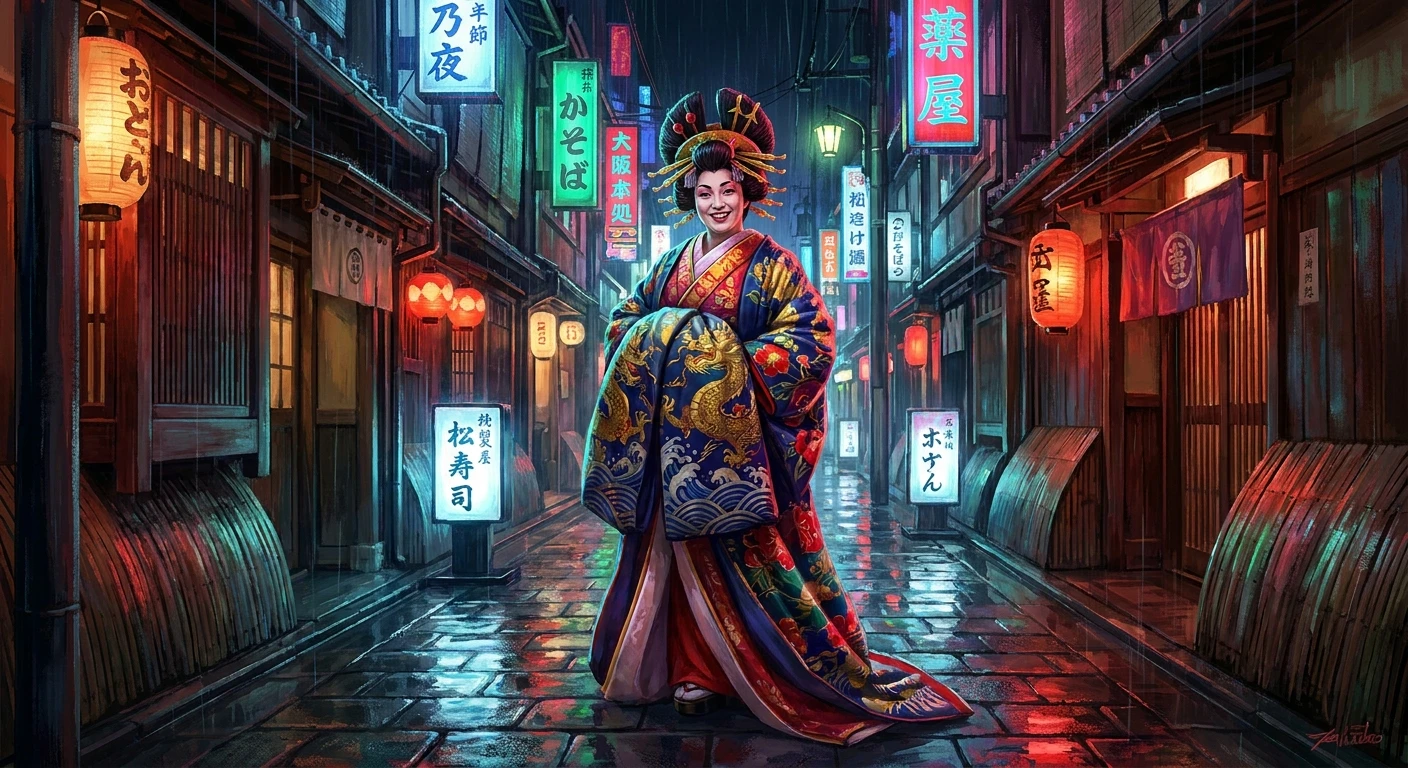
So, What Exactly Is a Kabukimono?
Have you ever heard of a kabukimono before? Sitting here in a buzzing cafe in downtown Kyiv, nursing my espresso while the winter wind rattles the windowpanes, I was just watching the street style outside. A group of local teenagers walked by wearing the most brilliantly chaotic, clashing, rule-breaking outfits you could possibly imagine. Seeing their fearless self-expression instantly reminded me of the original architects of street rebellion from centuries ago. I realized we seriously need to talk about these historical disruptors. You might think punk rock or avant-garde fashion started sometime in the twentieth century, but the truth is entirely different. The true blueprint for rebelling through aesthetics was drafted in Japan hundreds of years ago by gangs of masterless samurai and restless youths.
This aesthetic movement was not just about wearing flashy clothes; it was a loud, visible protest against a society obsessed with extreme order and rigid conformity. The thesis is simple: when society tries to lock human expression into strict little boxes, human nature will inevitably explode outward in the most colorful, dramatic way possible. These historical fashion punks proved that clothing is never just fabric—it is a megaphone. By adopting their mindset, we can learn a lot about standing our ground, challenging the status quo, and refusing to blend into the gray background of everyday life. Let us break down exactly how they pulled it off and why their legacy still matters for anyone who wants to live loudly and authentically.
Read also: mtg final fantasy Guide: Build Ultimate Decks; Why og fortnite skins Rule the Game.
The Core Mechanics of Aesthetic Rebellion
To truly grasp the vibe, you have to understand both the benefits and the friction these groups caused. At their core, these individuals were social disruptors. The benefit of their lifestyle was absolute psychological liberation. Imagine living in a society where the government dictates exactly what color you are allowed to wear based on your birth rank. By aggressively breaking those rules, they reclaimed their personal autonomy. They created an entirely new subculture that provided a sense of belonging for the outcasts, the eccentric, and the disenfranchised. However, this level of defiance definitely brought harm too. They often clashed with authorities, sparked street brawls, and faced severe crackdowns from the ruling shogunate, who viewed their loud existence as a direct threat to national stability.
Their value proposition to the cultural landscape was immense. They introduced the concept that personal style could be weaponized. For example, they would wear women’s kimonos over their armor, or they would utilize imported European velvet, which was strictly forbidden for their class. Another clear example is their grooming—while standard samurai maintained meticulous, standardized topknots, these rebels let their hair grow wild or styled it asymmetrically to deliberately offend polite society.
Here is a quick breakdown comparing the standard fashion of the era to their rebellious style:
| Fashion Element | Traditional Samurai | Rebel Approach |
|---|---|---|
| Color Palette | Muted browns, blacks, and indigos | Neon-like crimsons, bright yellows, and loud purples |
| Accessories | Standard swords, functional armor | Oversized smoking pipes, imported trinkets, deliberately long swords |
| Behavioral Vibe | Silent, obedient, stoic | Loud, theatrical, flamboyant, boastful |
If you want to spot their ongoing influence in modern media and fashion, look for these three distinct markers:
- Deliberate Asymmetry: Outfits that intentionally imbalance the silhouette, like one sleeve missing or wildly contrasting patterns on either side of a jacket.
- Gender-Fluid Styling: The seamless blending of traditionally masculine and feminine garments to create a look that defies strict categorization.
- Theatrical Confidence: Carrying oneself with an exaggerated swagger that demands attention, turning everyday sidewalks into a personal runway.
Origins in the Sengoku Period
The story essentially begins at the tail end of the Sengoku period, which was an era of endless, brutal civil war. For over a century, social mobility was surprisingly fluid because if you could fight, you could rise in the ranks. But as the wars finally wound down and peace began to take hold, tens of thousands of young warriors suddenly found themselves unemployed, bored, and locked out of the new, rigid social hierarchy. They had fighting skills, massive egos, and absolutely zero outlets for their energy. They became masterless ronin and disenfranchised youths who banded together. Since they could no longer express themselves on the battlefield, they decided to wage war on social norms instead.
Evolution During the Edo Period
As the Edo period solidified its grip, the government passed incredibly strict sumptuary laws. These laws literally dictated the fabric, color, and cut of clothing every single social class was allowed to wear. The government wanted a perfectly ordered society. In response, the street gangs doubled down. Their fashion evolved into hyper-exaggerated parodies of upper-class wealth. They began carrying comically oversized smoking pipes, wearing patchwork robes made from forbidden silks, and strutting through the streets speaking in invented slang. They were no longer just bored ex-soldiers; they became a massive counter-cultural movement. Their evolution directly birthed new art forms. The very word for their behavior eventually lent its name to the famous avant-garde theater of Japan, which began as wild, unconventional performances heavily inspired by their street antics.
Modern State and Pop Culture
Fast forward to the present day. It is wild to think that even now in 2026, we are experiencing a massive resurgence of this exact same energy in global street fashion. You can see their spiritual descendants in modern Harajuku fashion, in avant-garde European runways, and even in massive video games. Think about popular anime or gaming characters who wear giant hats, asymmetrical robes, and boast chaotic, unpredictable personalities. Creators are constantly borrowing from this historical archetype because the concept of the flamboyant, unstoppable rebel is universally appealing. They went from being the outlaws of the seventeenth century to the ultimate pop culture icons of today.
The Sociology of Deviant Aesthetics
Let us look at the science of why this works. In sociological terms, what these individuals were doing is known as deviant signaling. When a society is hyper-structured, humans experience extreme cognitive dissonance if their internal identity does not match their external permitted expression. By adopting visually jarring aesthetics, they forcefully resolved this dissonance. The bright colors and asymmetric shapes acted as a non-verbal boundary marker, instantly signaling to other outcasts that they belonged to the same ingroup, while simultaneously intimidating the outgroup (the conservative authorities). Psychologically, wearing loud, “forbidden” clothing triggers a release of dopamine and adrenaline, reinforcing the wearer’s sense of personal agency and power.
The Textile Technology of Rebellion
From a technical standpoint, achieving these looks was actually quite scientifically complex for the time. The dyes required to achieve the eye-watering crimsons (derived from safflower) and the deep, vibrant purples (derived from lithospermum root) were heavily restricted and incredibly expensive to process. These dyes required specific mordants—chemical binding agents like aluminum salts—to make the colors fast and brilliant. The rebels had to rely on underground artisans who mastered complex resist-dyeing techniques.
- Safflower Extraction: Creating the forbidden bright reds required washing safflower petals repeatedly in cold water to remove yellow pigments, a highly labor-intensive chemical process.
- Loom Disruption: Artisans intentionally altered loom tensions to create uneven, textured fabrics that mocked the smooth, flat silks of the aristocracy.
- Visual Weighting: By studying contrast, they scientifically paired complementary colors (like deep indigo next to bright orange) to maximize optical vibration, forcing people to look at them.
Your 7-Day Guide to Embracing the Aesthetic
You do not need an oversized sword or a time machine to channel this energy. You just need the courage to break your own fashion rules. Here is a totally doable, week-long plan to inject some much-needed rebellion into your everyday life.
Day 1: Audit Your Wardrobe
Start by tearing through your closet. Pull out all the neutral, safe, boring clothes that you wear just to blend in. Put them in a pile. Now, find the pieces you bought because you loved them, but you have been too scared to wear out of the house. Those are your new foundation pieces.
Day 2: Introduce Bold Asymmetry
Take one of your favorite outfits and intentionally throw it off balance. Tuck in only one side of your oversized shirt. Wear a single, dramatic earring. Roll up one pant leg. Asymmetry forces the eye to do a double-take and screams that you are not bound by symmetry.
Day 3: Mix Unconventional Patterns
Today, we clash. Grab a striped button-down and pair it with a floral jacket or plaid trousers. The trick to making it look intentional rather than accidental is keeping one underlying color consistent across the patterns. Own the visual noise.
Day 4: Adopt a Signature Accessory
Historically, they carried massive pipes. For you, it could be an oversized vintage ring, a wildly colorful scarf, or a pair of neon boots. Find one accessory that is completely unreasonable for a normal Tuesday, and wear it with absolute pride.
Day 5: Master the Confident Strut
Fashion is only 50 percent of the equation; the rest is pure attitude. When you walk down the street today, keep your chin parallel to the ground, swing your shoulders slightly, and take up space. Do not shrink yourself when walking past strangers.
Day 6: Challenge a Social Norm
Apply the mindset beyond your clothes. Speak up directly in a meeting where you usually stay quiet. Send that bold message you have been drafting. The core philosophy is about disrupting the comfortable silence.
Day 7: Own Your Complete Look
Combine everything. Wear the clashing patterns, the asymmetrical tuck, and the loud accessory, and walk out the door with that unshakeable swagger. You might get weird looks, but remember: you are not dressing for their comfort. You are dressing for your freedom.
Myths vs. Reality
There is a lot of misinformation floating around about these historical punks. Let us clear the air and set the record straight.
Myth: They were just common street thugs and thieves.
Reality: While some resorted to crime, many were actually highly educated, high-born samurai who were protesting political disenfranchisement through performance art.
Myth: Their fashion choices were completely random and chaotic.
Reality: Every single clashing color and weird accessory was a calculated, deliberate subversion of the highly specific sumptuary laws of the Edo government.
Myth: The movement completely died out and left no cultural trace.
Reality: They are directly responsible for the creation of Japan’s most famous traditional performing art, which literally took its name and flamboyant style from these street rebels.
Myth: It was a strictly male-only subculture.
Reality: Women actively participated in the aesthetic, most notably the legendary dancer Izumo no Okuni, who cross-dressed in their signature style and revolutionized entertainment.
Frequently Asked Questions
What does the word actually mean?
It translates roughly to “those who lean out” or “the eccentric ones.” It comes from a verb meaning to slant, slope, or act in an unusual, unconventional manner.
Did they invent traditional theater?
They inspired it! Their wild street fashion and dramatic, exaggerated posturing became the direct foundation for the highly stylized theater that shares their name.
Were they officially outlawed?
Yes, the shogunate viewed them as a massive threat to public order and passed severe laws banning their specific hairstyles, clothing styles, and public gatherings.
Did they carry specific weapons?
They famously carried dramatically oversized swords, often with brightly painted, customized scabbards, not necessarily for fighting, but for visual intimidation and showing off.
Are there modern equivalents to this group?
Absolutely. You can see their spirit in punk rockers of the 70s, the grunge movement of the 90s, and modern Harajuku street fashion kids who defy societal norms.
Why were bright colors so controversial?
In that era, bright colors were legally reserved only for the ultra-wealthy aristocracy. Wearing them as a commoner or ronin was a literal crime and a slap in the face to the government.
Can I pull off this aesthetic today?
100 percent yes. The essence isn’t about wearing a 17th-century kimono; it’s about unapologetic self-expression, mixing bold colors, and refusing to follow boring fashion rules.
So there you have it—a deep dive into the original bad boys and girls of street fashion. They proved that what you wear can be a radical act of defiance. Do not let society dictate how you express your inner fire. Go to your closet right now, pull out that one wild piece you have been too nervous to wear, and take it for a spin. Stay bold, keep rebelling, and own your aesthetic!




Leave a Reply