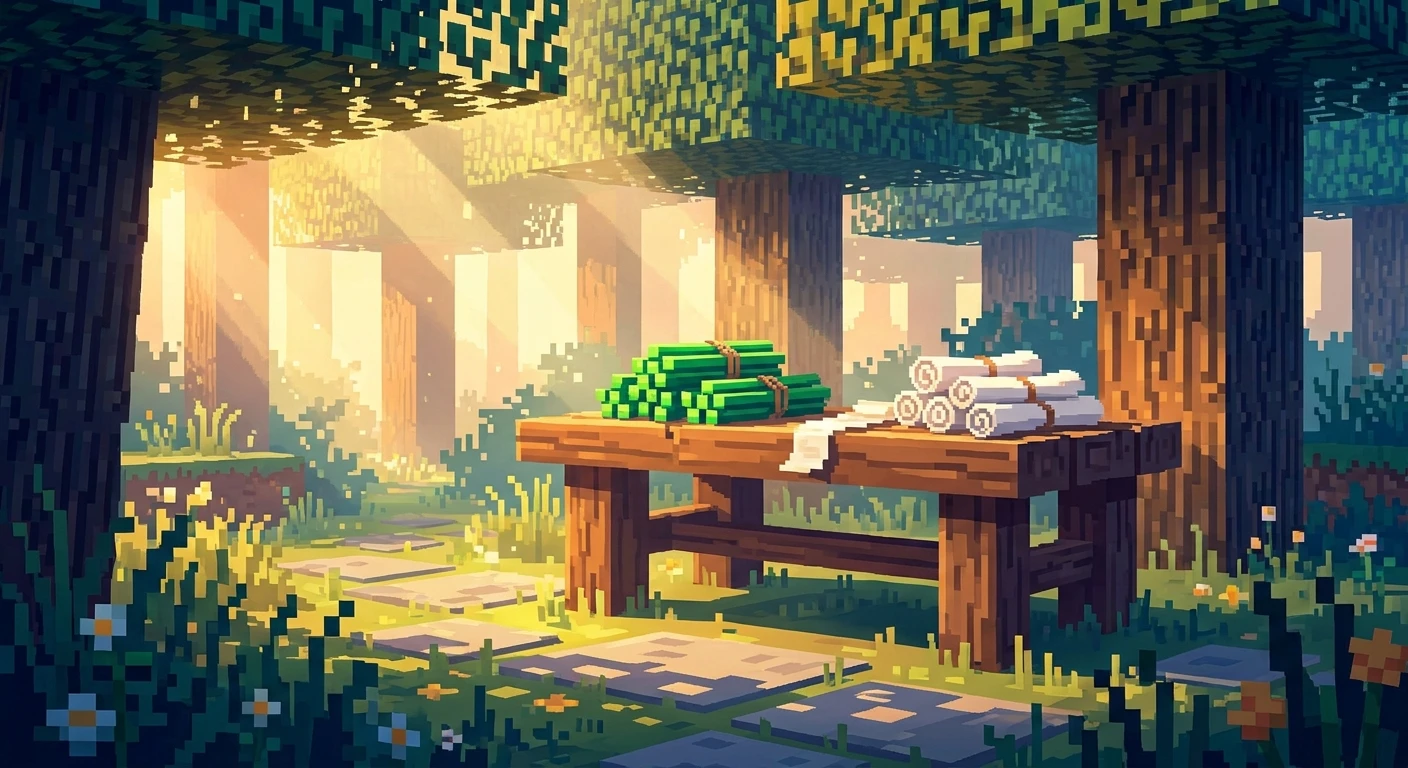
The Ultimate Guide on How to Make Paper in Minecraft
So, you are sitting at your crafting table and wondering how to make paper in minecraft, right? Honestly, I have been there more times than I can count. Picture this: it is a freezing evening here in Kyiv, the power grid is doing its usual dance of rolling blackouts, and I am huddled under a thick blanket with my laptop running purely on battery power. Playing offline survival has become my absolute favorite way to unwind when the lights go out. I was trying to build this massive, towering library to get my enchanting table up to the maximum level thirty. The walls were empty, the aesthetic was totally lacking, and I desperately needed bookshelves to make the magic happen. That is exactly when the realization hit me hard—I needed a massive amount of parchment, and I needed to produce it fast. The process of gathering the resources and aligning them correctly on the grid is simple once you know the exact pattern, but getting to an industrial-level production takes a bit of real planning. You just need three pieces of sugarcane laid out horizontally across the crafting grid. But gathering those first three green stalks and multiplying them is an entire journey of its own. Let us break down everything you need to gather, process, and utilize to fuel your blocky adventures and make your base truly legendary.
Why This Matters for Your Survival World
Understanding the core mechanics of your resources is what separates a beginner player from an absolute veteran. Once you get your farming infrastructure up and running, you are basically printing unlimited potential. The crafting recipe itself is incredibly straightforward: open your inventory or crafting table, grab three sugarcanes, and place them in a single horizontal row. You get three sheets in return. But the true value proposition comes from what you do with it next. Think about your progression. You cannot trade with librarians effectively without it. You cannot chart your world without maps. You cannot build the rockets necessary for elytra flight without an abundant supply. Let me show you a quick breakdown of the core materials involved in this entire ecosystem.
| Material Name | Gathering Location | Primary Use Case |
|---|---|---|
| Sugarcane Stalks | Riverbanks, Swamps, Desert coasts | Base raw ingredient for crafting |
| Water Bucket | Any infinite water source | Required irrigation for crop growth |
| Sand or Dirt Block | Plains, Deserts, Beaches | Planting surface adjacent to water |
To really maximize your efficiency, you want to set up a dedicated farming zone near your main base. If you are constantly running across the map just to harvest a few stalks, you are wasting precious daylight and risking creeper encounters. Here is the absolute best way to establish your first permanent farm.
- Locate a flat area near your base and dig a trench that is one block wide and exactly eight blocks long.
- Pour a single water bucket at one end of the trench so it flows perfectly to the other side without spilling over.
- Plant your gathered stalks on the dirt or sand blocks directly touching that flowing water trench.
- Wait for the stalks to grow to three blocks tall, then carefully punch only the middle block so the top breaks off and the bottom remains planted for endless regrowth.
The Origins of Sugarcane in the Blocky World
If we look back at the early days of development, things were completely different. Back in the Alpha and Beta phases, the green stalks you see today were actually called reeds. They spawned exclusively near coastlines and had very limited functionality. Veteran players remember when the only real reason to harvest them was just for aesthetic decoration around artificial ponds. You would grab a few reeds, plant them near your wooden shack, and completely forget about them. The entire economy of the game had not yet realized the potential of these tall, hollow plants.
Evolution of Crafting Mechanics
As the game evolved, so did the necessity for raw materials. The introduction of the enchanting system completely revolutionized survival gameplay. Suddenly, everyone desperately needed bookshelves, which meant everyone needed leather and bound pages. Then came the villager trading updates. Librarians became the most valuable entities in the game because they offered elite enchantments like Mending. To get those enchantments, you had to trade them raw items for emeralds. This single change turned simple riverbank foraging into a massive industrial requirement. Players started designing massive, complex redstone machines purely to automate the harvesting process.
Modern State of Paper Crafting in 2026
Fast forward to gaming in 2026, and the mechanics have reached a beautifully refined state. While the basic recipe of three horizontal stalks has never changed, the surrounding mechanics have grown incredibly deep. Modern survival bases feature fully automated observer-based harvesting machines that run endlessly while you are out exploring. The demand has only skyrocketed with the addition of advanced fireworks for Elytra propulsion. If you want to fly across your server without stopping, you need gunpowder and an infinite supply of these crafted sheets. The humble reed has truly become the backbone of late-game travel and magical progression.
The Botany of Sugarcane Generation
Let us get slightly technical for a moment, because understanding the underlying code mechanics gives you a massive advantage. Sugarcane generation relies on a specific algorithm that triggers during chunk creation. When the world generates a new chunk, the game checks for bodies of water—rivers, oceans, or small ponds. It then checks the blocks directly adjacent to that water. If the block is sand, dirt, podzol, or mud, there is a random chance for a stalk to spawn. This generation ignores biomes for the most part, though it is slightly more prevalent in swamps and deserts due to the terrain generation rules. Once planted, the growth mechanic is entirely governed by random tick speed.
Crafting Grid Geometry and Ticks
Every block in the game receives updates based on a random tick interval. By default, this is set to three random ticks per chunk section per second. For a stalk to grow, the top block must receive a specific number of these random ticks, accumulating internally until it reaches sixteen. Once it hits that magical number of sixteen internal ticks, the game checks if there is empty air above it. If yes, it places a new stalk block. The maximum natural height is three blocks. Here are some crucial scientific facts about this plant’s behavior in the game engine.
- Growth rate consistency: It takes approximately eighteen real-world minutes for a freshly planted stalk to reach its maximum height of three blocks under normal conditions.
- Light independence: Unlike wheat or carrots, this plant completely ignores the light level. It will grow in absolute pitch-black darkness deep underground as long as it is next to water.
- Block update disruption: If the water source block adjacent to the plant is removed or turns to ice, the stalk will instantly break upon the next block update, dropping as an item.
- Zero collision hitboxes: You can walk straight through the stalks without your movement speed being hindered, making them excellent hidden doorways for secret base entrances.
Step 1: Scouting the Riverbanks
Your first mission is purely exploratory. Grab a sword, a little bit of food, and start walking along the nearest river or ocean coastline. You are looking for tall, bright green stalks. You only really need a single block to start an entire empire, but grabbing at least ten will make your initial farming setup much faster. Do not bother exploring deep into forests or mountains; stick strictly to the water’s edge where the sand meets the water.
Step 2: Harvesting the First Yield
When you spot your prize, do not overcomplicate things. You can punch the base block with your bare hands. It breaks instantly and drops the entire stalk as collectible items. Make sure they do not fall into a flowing river and drift away. Gather them up in your inventory and immediately head back to the safety of your main base before nightfall.
Step 3: Digging the Irrigation Trenches
Back at your base, find a flat patch of land. Equip a shovel and dig a straight line in the dirt. It can be as long as you want, but an eight-block trench is the most efficient because a single water bucket flows exactly eight blocks. Go to a nearby lake, scoop up some water, and dump it at the very edge of your new trench. Watch the water flow perfectly to the end.
Step 4: Planting the Seeds of Knowledge
Walk alongside your new miniature river. Take the stalks from your inventory and right-click on the dirt blocks directly touching the water. If you try to plant them even one block away from the water, the game will completely reject the action. Plant them closely together in a neat, organized row to maximize your spatial efficiency.
Step 5: Waiting for the Growth Ticks
Now comes the hardest part: patience. The chunks containing your farm must remain loaded in memory for the crops to grow. This means you need to stay relatively close to your base. Go mine some iron, organize your storage chests, or build a house. As long as you are within simulation distance, the random ticks will do their job and push those green stalks toward the sky.
Step 6: The Harvesting Technique
Once your plants are three blocks tall, it is time for the harvest. Here is a crucial tip: never break the bottom block. If you break the bottom, you have to replant everything manually. Instead, aim your crosshair exactly at the middle block and punch it. The top two blocks will break off and fall to the ground, leaving the root perfectly intact to continue growing indefinitely.
Step 7: Mastering the Crafting Table
Gather your massive haul and walk over to your crafting table. Open the three-by-three grid. Take three of your stalks and place them horizontally right across the middle row. One, two, three. Instantly, the output box will display three crisp, white sheets. Shift-click the output to instantly transfer your new material into your inventory. You are now a fully certified manufacturer ready to conquer the arcane arts.
Myth: Sand Makes It Grow Faster
Reality: This is perhaps the oldest and most stubborn rumor in the entire gaming community. Many players swear that planting your stalks on sand blocks drastically increases their growth rate compared to dirt. Extensive testing and direct analysis of the game code have proven this is completely false. Dirt, sand, mud, and podzol all yield the exact same random tick growth times. The confusion likely stems from the fact that they naturally spawn on sand more often.
Myth: You Need Torches for Night Growth
Reality: Unlike traditional crops that require a specific light level to advance their growth stages, this specific plant totally ignores ambient light. You can build a massive underground farm completely sealed in obsidian without a single torch, and as long as the water is present and the chunk is loaded, it will continue to grow at its normal eighteen-minute pace.
Myth: Bone Meal Works Everywhere
Reality: If you are playing the Java Edition on a PC, bone meal has zero effect on these stalks. You cannot speed up the process artificially. However, if you are playing the Bedrock Edition on a console or mobile device, bone meal actually does work to instantly grow the plant to maximum height. This version difference trips up thousands of players who switch platforms.
Can I eat sugarcane?
No, you cannot consume it directly to restore your hunger bar. While you can craft it into sugar, which is then used to bake cakes and pumpkin pies, the raw stalk itself is completely inedible.
Do I need a crafting table to make this?
Actually, no. Because the recipe only requires a horizontal row of three items, it fits perfectly into the two-by-two crafting grid located natively inside your personal inventory screen. You can craft on the run.
Can I craft books without leather?
No. In current versions of the game, a standard book strictly requires three pages and one piece of leather gathered from cows, horses, or hoglins. You cannot bypass the leather requirement for traditional binding.
What is a cartography table used for?
It is a specialized workstation that allows you to expand, copy, and lock maps using much less material than doing it on a standard grid. It is highly recommended if you are heavily invested in exploring your seed.
Will flowing water break my plants?
Yes. If a water stream physically washes over the block the plant is sitting on, it will uproot the plant entirely. Always ensure your irrigation trenches are one block lower than your planting surface.
How many pages do I need for a full enchanting setup?
To reach level thirty enchantments, you need exactly fifteen bookshelves. Each shelf requires three books, and each book requires three pages. Therefore, you need one hundred and thirty-five individual sheets total to reach maximum power.
Can villagers harvest this crop?
No, farmer villagers only interact with traditional crops like wheat, potatoes, carrots, and beetroot. If you want to automate this specific resource, you must rely on pistons and observer blocks rather than villager labor.
You now hold all the knowledge necessary to completely dominate the economy of your survival world. From tracking down those first wild shoots on a sandy beach to building towering walls of knowledge around your glowing enchanting altar, mastering this basic resource changes everything about how you play. Stop hesitating, boot up your save file, grab a bucket of water, and start building the ultimate automated farm today!


Leave a Reply