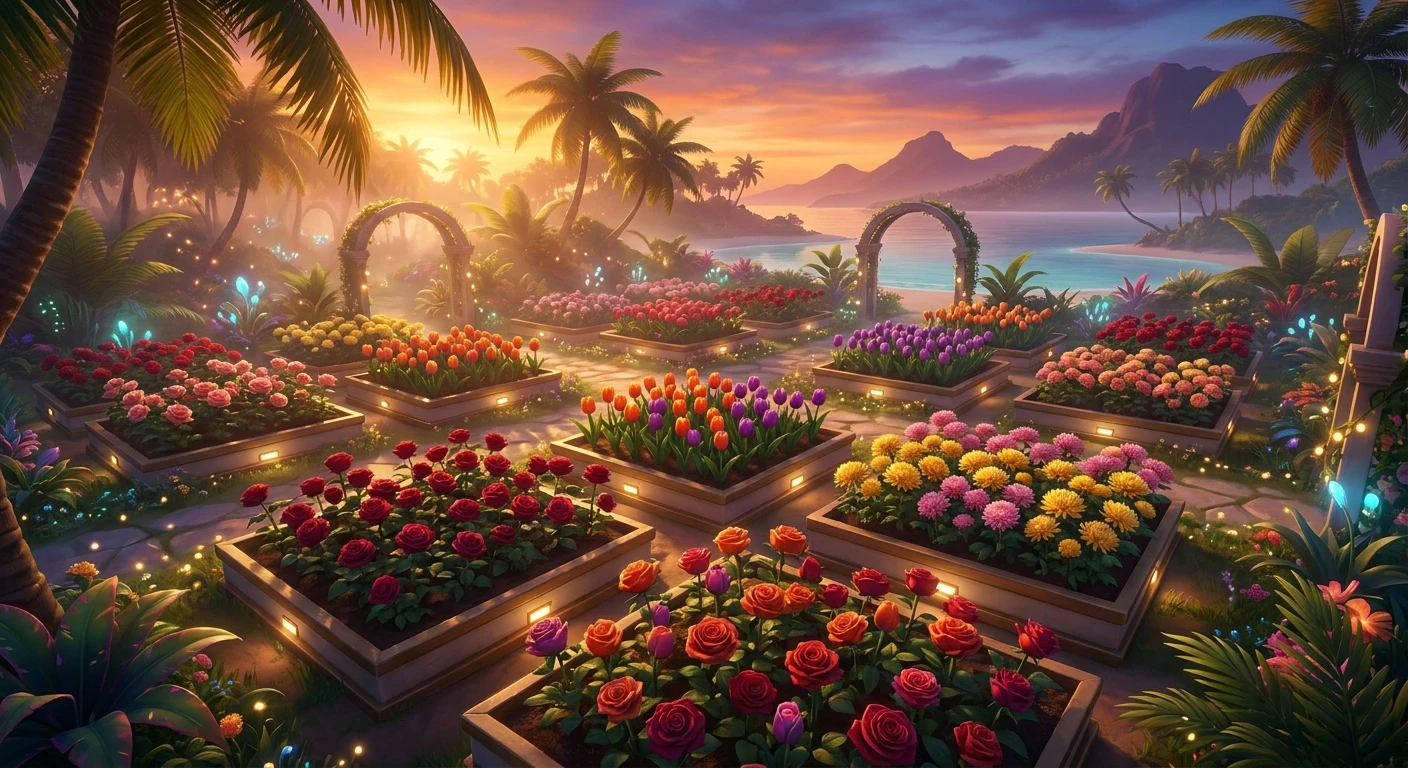
The Ultimate acnh flower breeding guide
Hey everyone, if you are looking for a completely foolproof acnh flower breeding guide, you landed in the exact right spot. I still vividly remember sitting in my Kyiv apartment during the rolling power blackouts a few winters back. While the city outside was dark and freezing, my Nintendo Switch screen was glowing bright, entirely consumed by the colorful, sunny grid layouts of my Animal Crossing island. I spent countless hours by candlelight watering digital tulips and desperately hoping for a purple windflower to spawn. It kept my spirits up and gave me a sense of control during a highly unpredictable time. Now that we are well into the year 2026, the basic mechanics of hybridizing blossoms in New Horizons haven’t changed, but the community’s understanding of the underlying genetics has reached absolute perfection. This game secretly runs on a complex system of digital DNA, which means getting those coveted blue roses isn’t just about random luck—it requires a solid, mathematical plan. My thesis here is simple: if you understand the hidden code and follow a strict planting grid, you can mathematically guarantee every single rare hybrid flower in the game without losing your mind. I am going to walk you through exactly how I turned a messy patch of starter seeds into a perfectly engineered botanical garden, saving you weeks of frustration and wasted watering cans.
Why should you even care about hybridizing to this extreme degree? Well, beyond the obvious aesthetic flex of having a tropical island entirely covered in black cosmos or purple hyacinths, mastering this system offers massive gameplay advantages. The value proposition here is huge. For example, rare hybrids attract extremely rare and valuable bugs. Peacock butterflies spawn almost exclusively around blue, purple, and black blooms, which means you have a reliable, high-tier income stream for paying off those massive Tom Nook loans. Another prime example is crafting. If you want to craft the gorgeous flower stands or chic wreaths to decorate your villagers’ homes, you absolutely must have rare hybrids like pink windflowers or black roses. Knowing the exact parent combinations gets you those required crafting materials incredibly fast, rather than waiting months for a lucky random spawn.
| Watering Method | Grid Coverage Area | Hybridization Boost Rate |
|---|---|---|
| Standard Watering Can | Up to 1×3 blocks directly ahead | Standard 5% base spawn rate |
| Golden Watering Can | A massive 3×3 grid (9 blocks total) | Standard rate, but strictly required to spawn Gold Roses |
| Island Visitors (Friends) | Depends on their chosen tool | Massive boost up to 80% with 5 different visitors |
Here is the absolute truth about making your garden work efficiently without pulling your hair out:
- Always start your journey with fresh seeds from Leif or Nook’s Cranny. Native flowers growing wild on your cliffs or plants taken from mystery islands have entirely unknown genetic histories. A hidden stray gene will completely ruin complex breeding paths. You need the blank slate that store-bought seeds provide.
- Leave ample breathing space for new offspring. If your flowers are packed too tightly against terraformed cliffs, brick fences, or houses, the new buds literally have nowhere to spawn. They need at least one empty dirt or grass tile adjacent to them.
- Exploit the multiplayer visitor bonus to its maximum limit. Having five different friends fly over the internet to water your garden increases the chance of a new flower spawning the very next day to an insane 80 percent. It is the single biggest time-saver in the entire game.
Origins of the Genetic Code
When New Horizons first dropped, casual players and veterans alike assumed the flower mechanics were as simple as previous titles in the franchise: red plus red equals black, right? Not quite. Early in the game’s lifecycle, dedicated dataminers cracked open the game files and discovered a terrifyingly accurate Mendelian genetics system running silently in the background. Every single flower generated by the game holds four distinct gene pairs: Red, Yellow, White, and a special Shade or Brightness gene. This revelation blew the community’s collective mind. We realized we weren’t just putting two pretty colors next to each other and hoping for a visual mix; we were literally crossing dominant and recessive alleles just like a high school biology experiment. This discovery changed how everyone approached island landscaping overnight.
Evolution of Breeding Layouts
At first, everyone used the standard, visually pleasing checkerboard pattern. It looked like a neat little farm and seemed intuitive. But as players desperately tried to get the rarest colors—especially the infamous blue rose—the checkerboard proved highly flawed. It allowed too many unwanted combinations, random cross-pollinations, and stealthy clone spawns that masqueraded as true hybrids. The community quickly evolved. We shifted away from messy checkerboards to isolated pairs, then to the “turtle” layout, and eventually settled on the highly optimized “diamond” and “hexagon” grids. These modern layouts physically guarantee that only the specific parent flowers you want will interact with each other. Dedicated fans were sharing massive Google spreadsheets and dizzying flowcharts on social media just to track the percentage chance of a green mum spawning. It became a global collaborative puzzle.
Modern State of Island Botany
Fast forward to the current era, and the science of ACNH botany is fully mapped out and standardized. By 2026, nobody uses guesswork anymore unless they are intentionally doing a relaxed, casual playthrough. We have exact, heavily verified step-by-step paths that minimize RNG (random number generation) and maximize your daily output. The modern player treats their garden less like a casual backyard and more like a high-tech agricultural laboratory. You isolate your specific test subjects, you rigidly monitor the offspring, you ruthlessly discard the failed clones, and you leverage Discord communities to get that crucial visitor watering bonus to force rapid mutation. It sounds incredibly intense for a cozy game, but having a foolproof, mathematical roadmap makes it incredibly satisfying. You aren’t just hoping for the best; you are engineering pure botanical success from the ground up.
Understanding Mendelian Genetics in ACNH
Let’s talk about how the math actually operates behind the game engine’s cute aesthetic. Every single flower has a genotype represented by internal numbers, usually written by the community as RR-YY-WW-Ss. These letters stand for Red, Yellow, White, and Shade. Each individual gene pair can have a value of 0, 1, or 2. A zero means the gene is totally missing or recessive, a one means it’s mixed or heterozygous, and a two means it’s fully dominant or homozygous. When two flowers successfully breed, they randomly pass on exactly half of their gene values to their new offspring. This is exactly why two red roses can produce a black rose, a pink rose, or just another red rose that secretly has completely different hidden genetics than its parents. If you try to breed a blue rose using a red offspring that has the wrong hidden genes, you will literally have a zero percent chance of success. The math simply will not allow it to happen, no matter how many months you water it.
The Clone Protocol vs True Hybrids
One of the absolute biggest hurdles for beginners is telling the difference between a true genetic hybrid and a sneaky clone. If a flower is watered but has no valid partner nearby, or if the RNG decides not to pair it with its neighbor, it will just duplicate itself in an empty adjacent square. This clone has the exact same DNA as the parent. If you accidentally mistake a clone for a true hybrid offspring, you will move it to your next breeding phase and entirely ruin your chain. To prevent this disaster, you have to use specific layouts where flowers only ever touch the partner you want them to breed with, and you must know exactly what colors indicate a successful mix.
- Seed flowers bought from the store always have the exact same starting DNA (for example, all seed Red Roses are exactly 2-0-0-1).
- Watering a flower only flags it for a chance to reproduce; it never guarantees a spawn will happen the next day.
- The baseline spawn chance is a meager 5%. One visitor bumps it to 25%, and five visitors max it out at 80%.
- Gold roses do not follow genetic rules; they are the final end-state product of black roses watered exclusively with a golden can, and they cannot breed further.
Step 1: Procuring Your Base Seeds
Your grand operation begins at the shops. Clear your pockets and head to Nook’s Cranny, or wait patiently for Leif to visit your plaza. Buy massive stacks of Red, White, and Yellow seed bags for the specific flower species you are targeting. Never, under any circumstances, dig up fully grown flowers from your cliffs for complex breeding paths. You absolutely need the genetic blank slate that only sealed seed bags provide.
Step 2: Preparing the Testing Grounds
Find a large, wide-open, flat area on your island. Dig up all the pesky weeds, chop down any obstructing trees, and lay down in-game dirt paths to clearly mark your grids. I highly recommend using the dark dirt path because it makes the bright flower stems visually pop and keeps your horizontal rows perfectly organized. Fencing off the area also stops villagers from wandering in and sitting directly on your workspace.
Step 3: Planting the First Generation
Plant your fresh seeds in strictly isolated pairs. If you are going for the notoriously difficult blue rose path, you need to start by planting White seeds diagonally next to White seeds to get Purple offspring. In a separate grid, plant Red seeds next to Yellow seeds to generate Orange offspring. Ensure these two zones are physically separated by at least two empty tiles so they never cross-contaminate.
Step 4: Implementing the Watering Routine
Water every single pair meticulously. If you have Nintendo Switch Online, text your friends or hit up a Discord server. Bribe visitors with Nook Miles Tickets, Bells, or rare furniture to come water your flowers. Getting five people to use their cans on your plots is the absolute key to speeding this up from a months-long grind to a manageable weekend project.
Step 5: Culling the Rejects
The next morning at 5:00 AM, the daily reset happens. Check your garden beds immediately. Dig up any colors you don’t specifically need and either sell them to Timmy and Tommy or throw them directly in a trash can item. If a pair produces the correct color, carefully move it to a completely separate “holding area” so it doesn’t accidentally breed backwards with its parents.
Step 6: Testing the Offspring
For advanced paths, you actually have to test your new hybrids to ensure they aren’t clones. For example, if you need a specific “hybrid red” rose, you must breed an offspring with a pure seed white rose. If it produces a certain test color, you know its invisible genetics are mathematically correct. If it fails the test, you must ruthlessly dig it up and trash it. No exceptions.
Step 7: The Final Breeding Phase
Once you have painstakingly verified your perfect genetic parent flowers, plant them together in an isolated patch and water them daily. When that first incredibly rare Blue Rose or glowing Green Mum finally pops out of the ground, dig it up immediately. Place it completely by itself in an empty field, and just water it daily. It will infinitely clone itself, giving you an endless supply of the rarest item in the game.
There is so much wild misinformation floating around the community regarding horticulture. Let’s clear it up right now.
Myth: Rain produces much better, higher-tier hybrids than regular watering cans do.
Reality: Rain functions exactly like a standard, basic watering can. It absolutely saves you real-life time and preserves your tool durability, but it does not give you any hidden genetic bonuses or increased spawn rates compared to just watering them yourself.
Myth: You can breed two gold roses together to get more gold roses infinitely.
Reality: Gold roses are entirely genetically sterile. They will never produce offspring, and they will not even produce clones of themselves. You can only get more of them by continuously watering black roses with a golden watering can.
Myth: The classic checkerboard pattern is the most efficient layout for saving space.
Reality: The checkerboard pattern causes adjacent flowers to cross-pollinate wildly and unpredictably. Isolated pairs or the “diamond” layout are far superior because they strictly control which flowers interact, entirely preventing unwanted clones and messy genetic lines.
Myth: Mystery Island flowers are great for skipping breeding steps.
Reality: They used to be fantastic in the very early days of the game’s release, but Nintendo deliberately patched out the rare hybrid islands. Now, standard Mystery Island flowers just have messy, unknown genetics. Stick to seeds from Leif.
Do I need a golden watering can for blue roses?
No, you only absolutely need a golden can for producing gold roses. Regular, flimsy, or colorful cans work perfectly fine for everything else.
Why won’t my green mums spawn?
You are most likely using standard, first-generation purple mums instead of the required hybrid purples. Double-check your breeding chain to ensure they came from hybrid yellows.
Can visitors from other islands ruin my garden?
Only if you have them registered as “Best Friends” on your NookPhone, which allows them to use a shovel. Regular visitors cannot dig; they can only help you by watering.
How long does the blue rose path actually take?
Without using the system settings to time travel, expect the most complex paths to take several weeks or even a couple of months, heavily depending on your daily RNG.
Do unwatered or wilted flowers die permanently?
No, flowers in New Horizons never actually die. They just lose their sparkle and stop growing or breeding until you give them water again.
Can I speed up the tedious process?
Yes, by time traveling forward day-by-day via the Switch console settings, or by leveraging the community to get five different visitors daily.
What is technically the hardest flower to get?
The Blue Rose is universally recognized as the hardest, requiring a brutal four-step genetic breeding process with extensive testing phases.
Can I place my breeding flowers on the sandy beach?
You can plant fully grown flowers in the beach sand for aesthetic decoration, but they will never produce buds, clone, or breed while on the sand.
Listen, building the ultimate botanical garden on your virtual island takes genuine patience, but it is deeply rewarding when it all comes together. Stick to the mathematical grids, strictly control the unseen genetics, and those brilliant, rare colors will eventually pop up to brighten your day. Start planting those base seeds today, set up your watering schedule, and drop a comment below if you finally snagged that elusive blue rose!

Leave a Reply