Mastering the Ring: How The Ring Tempts You Works in MTG
So, you’re sitting at the table, your buddy drops a Nazgul, and suddenly everyone is talking about the Ring tempting them. If you’ve been away from Magic: The Gathering for a bit or just recently picked up the Tales of Middle-earth set, this mechanic might feel like a lot to juggle. Honestly, it’s a bit weird at first. It’s not just a keyword; it’s an entire progression system that lives outside your deck. But once you get the hang of it, it’s actually one of the most flavor-packed things Wizards has ever done. Let’s break down how this whole “Ring” business actually functions without making your brain melt.
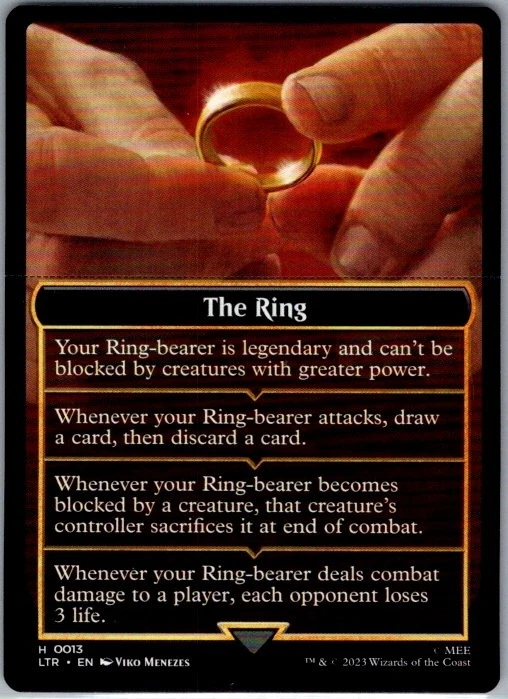
The first thing to understand is that the Ring is an emblem. You don’t “cast” the Ring. You don’t draw it. It just exists in the command zone or the “vibe zone” once the first card says those magic words: The Ring tempts you. When that happens, two things occur simultaneously. First, you choose a creature you control to be your Ring-bearer. Second, the Ring itself gains a new ability. If it’s the first time, it gets the level one ability. The next time you’re tempted, it moves to level two, and so on. It’s like a battle pass, but for Hobbits and Wraiths.
But what if you don’t have any creatures? This is where people usually get tripped up. You can still be tempted even if your board is totally empty. The Ring still levels up. You just don’t have anyone to actually carry the thing until you play a creature later. And once you do play a creature, the next time you are tempted, you can hand the Ring to that new recruit. It’s pretty flexible, though it definitely feels bad to level up a Ring with no one to hold it. Know what I mean?
The Four Stages of Corruption
The Ring has four distinct stages. Each time you are tempted, you move down the list. The cool part is that these abilities are cumulative. Level four includes everything from levels one, two, and three. It doesn’t reset when your Ring-bearer dies, either. If your bearer gets hit with a Path to Exile, the Ring stays at whatever level it reached. The next creature you pick just picks up right where the last one left off.
Let’s look at what these levels actually do for your creature. It starts small but ends up being a massive headache for your opponent. By the time you hit level four, that tiny 1/1 token you have might actually be the scariest thing on the board.
| Level | Ability Name | What it actually does |
|---|---|---|
| 1 | Stealth | Your Ring-bearer is legendary and can’t be blocked by creatures with greater power. |
| 2 | Looting | Whenever your Ring-bearer attacks, draw a card, then discard a card. |
| 3 | Deathtouch-ish | If your Ring-bearer becomes blocked, the blocking creature is sacrificed at end of combat. |
| 4 | The Burn | When your Ring-bearer deals combat damage to a player, each opponent loses 3 life. |
That first level is arguably the most important. Making a creature “legendary” matters for a lot of cards in the LotR set that care about legends. But the “can’t be blocked by creatures with greater power” clause is the real MVP. It means if you put the Ring on a 1/1 or a 2/2, your opponent can’t just throw a giant 6/6 dragon in front of it. They have to block with something small, or not block at all. It’s sneaky, flavorful, and incredibly annoying to play against.
Choosing the Right Ring-bearer
Since the Ring makes it hard for big stuff to block, you generally want your Ring-bearer to be something small with an “on-hit” effect or something you don’t mind losing. Putting the Ring on a massive 10/10 dinosaur is actually kind of a waste of the first ability because almost everything can block a 10/10. But a 1/1 with Skulk or Toxic? Now we’re talking.
If you’re playing a deck built around this, you’ll notice that some creatures get extra bonuses for being the bearer. Frodo, Sauron, and Gollum all have different versions that trigger specifically when they carry the burden. But honestly, even a generic 1/1 Soldier token becomes a threat once the Ring reaches level four. That 3-life drain adds up fast, especially in a game of Commander where you might be swinging every turn.
Another thing to keep in mind: you can change your Ring-bearer every single time you are tempted. You don’t have to stick with the same guy. If you play a better creature, or if your current bearer is about to die, just swap it. The “Legendary” status also moves with the Ring, which can be a double-edged sword if you’re trying to play around certain removal spells.
Common Strategies and Deck Synergy
In the current meta, especially for casual Canadian Commander nights, people are finding some wild ways to use this. You don’t need to go “full Sauron” to make it work. Just a few cards that tempt you can provide a lot of utility. The draw-discard effect at level two is great for graveyard decks. It lets you bin high-cost spells to reanimate later while digging for your combo pieces. It’s basically a free “Careful Study” every time you swing.
Here are some of the most popular cards that trigger the mechanic:
- Call of the Ring: This is probably the best engine for the deck. It tempts you at the start of your upkeep and lets you draw cards for a small life payment.
- Nazgul: You can have up to nine of these in your deck, and every time one enters, the Ring tempts you. They also grow whenever you are tempted.
- Frodo, Adventurous Hobbit: Great for low-to-the-ground decks that want to generate value early.
The sacrifice trigger at level three is another sleeper hit. It doesn’t matter how much toughness the blocker has. If they touch your Ring-bearer, they’re gone. It forces your opponent into a “lose-lose” situation. They either take the damage and let you loot, or they lose their creature. Most people will just take the damage, which brings us to level four-the finishing move.
Technical Nuances and Judge Calls
Let’s get a bit technical for a second. Magic is a game of rules, and the Ring has a few weird ones. For instance, if you have two copies of the same non-legendary creature, and one becomes the Ring-bearer, only *that specific permanent* is legendary. The other one stays normal. Also, if you lose control of your Ring-bearer (like with an Act of Treason), that creature is still the Ring-bearer for your opponent, but they don’t get *your* Ring’s benefits unless they also have a Ring emblem at that level. Actually, wait-the rules state the Ring-bearer status is tied to the player who was tempted. If your opponent steals your creature, it stops being a Ring-bearer for you, and it only becomes one for them if they are tempted and choose it.
Is it a bit much? Maybe. But compared to some of the mechanics we’ve seen in the past few years (looking at you, Initiative and Day/Night cycles), it’s actually pretty clean. The biggest hurdle is just remembering which level you’re on. Most bundles and prerelease kits came with a little tracker card. If you don’t have one, just use a d4 on a token. It saves a lot of arguing.
| Scenario | Result |
|---|---|
| Your Ring-bearer dies | You wait until the next “tempt” trigger to pick a new one. |
| You have no creatures | The Ring still levels up, but there is no active bearer. |
| Creature has Protection | Protection doesn’t stop the Ring from “choosing” a bearer. |
| Multiplayer games | Each player has their own independent Ring progression. |
Another thing to note for my fellow Canadians playing at local LGS events: the Ring mechanic is very self-contained. It doesn’t interact with “Venture into the Dungeon” or “The Initiative” in any way. They are all separate emblems. If you’re crazy enough to run all three in one deck, may God have mercy on your soul and your playmat space.
Is the Ring Actually Good?
Honestly? It depends on the format. In Draft and Sealed, it’s an absolute powerhouse. Being able to make a creature semi-unblockable is a game-winner in limited. In Standard or Modern, it’s a bit too slow for the top-tier decks, but in Commander, it’s a blast. It adds a layer of mini-games to the combat step that keeps things interesting. Plus, the flavor of Gollum finally getting his hands on the Ring only to be sacrificed for a level three trigger is just peak Magic.
If you’re building a deck, don’t feel like you have to include every single “tempt” card. Just pick the ones that provide actual value. Cards like “Birthday Escape” are basically a cantrip that levels your Ring-cheap, effective, and keeps the deck moving. You want to avoid the high-cost stuff that doesn’t do much else, because if your board gets wiped, those cards become dead in your hand.
Success with the Ring comes down to timing. You don’t always want to level it up as fast as possible if you don’t have a good creature to protect. Sometimes, holding back a tempt trigger until after you play a key creature is the smarter play. But then again, who can resist the power of the Ring? Certainly not me when I’ve got a handful of Nazgul.
Think about your local meta too. If everyone is playing big, stompy decks, the level one ability is going to be your best friend. If you’re facing a lot of control, the level two looting is what will keep you in the game. It’s all about adapting to the board state. And hey, if nothing else, it’s a great excuse to quote Lord of the Rings for two hours straight while your friends slowly lose their minds.
Key Takeaways for Your Next Game
Before you shuffle up, just keep these three things in mind. First, the Ring is permanent; it never goes back to level zero. Second, the choice of bearer happens *after* the Ring levels up. Third, and most importantly, don’t forget your triggers! The looting ability at level two is a “may” ability, but you almost always want to do it. Missing that draw can cost you the game.
- Always carry a tracker or a dedicated token for the Ring.
- Prioritize creatures with Evasion or Ward as your bearers.
- Remember that being tempted is a separate trigger from the bearer’s abilities.
It’s a weird mechanic, sure, but it’s one of those things that makes Magic what it is today. It’s complex, a little messy, but incredibly rewarding when you pull off a win with a lowly Halfling. Just try not to get too corrupted by the power, okay? Your playgroup might not appreciate you whispering “my precious” every time you draw a card.
The beauty of this system is how it scales. In the early game, it’s a minor nuisance. In the late game, it turns every top-decked creature into a potential threat. That’s the kind of pressure that wins games in EDH. So go ahead, let the Ring tempt you. It’s worth the risk.
How to Deal with the Ring-bearer
If you’re on the other side of the table, facing down a fully leveled Ring, you might be panicking. Don’t. The Ring-bearer is still just a creature. It can be destroyed, exiled, or bounced just like anything else. The key is to kill it *before* it attacks to prevent the level two and level four triggers. Since the level one ability only cares about power, try to block with something that has equal or lower power. A 1/1 token can block a 1/1 Ring-bearer all day long.
Also, remember that the “sacrifice a blocker” ability at level three only happens at the *end* of combat. If you block and then use an instant to sacrifice your own creature or blink it, you might be able to save some value. But honestly, the best way to stop the Ring is to stop the player. If they don’t have creatures, the Ring is just a piece of cardboard sitting on the sidelines.
Actually, one of the funniest ways to mess with a Ring-bearer deck is to use cards that strip abilities. A well-timed “Dress Down” or an “Oko, Thief of Crowns” (if you’re playing a format where he’s legal, God help you) turns that legendary, unblockable, soul-sucking threat back into a vanilla 3/3 Elk. There’s something very satisfying about seeing a Nazgul turned into a forest creature.
Anyway, that’s the long and short of it. The mechanic is deep, but it’s not impossible to master. Just take it one level at a time, and don’t be afraid to experiment with different bearers. You might find that some of your old, dusty cards have a whole new life once they start carrying the One Ring.
Who is the Ring-bearer?
The Ring-bearer is a creature you choose whenever the Ring tempts you. It gains special abilities based on the Ring’s current level.
Does the Ring reset if my creature dies?
No, the Ring stays at its current level for the rest of the game. Your next Ring-bearer will start at that same level.
Can I have more than one Ring-bearer?
Nope, only one creature can be your Ring-bearer at a time. If you are tempted again, you can choose a new one or keep the current one.
What happens if I have no creatures?
The Ring still tempts you and levels up, but you won’t have a Ring-bearer until you play a creature and get tempted again.
Is the Ring-bearer always Legendary?
Yes, as long as it’s carrying the Ring, that creature gains the Legendary supertype. This can be great for “Legends Matter” synergies.
Do I have to discard a card at level 2?
Yes, the level 2 ability is “draw a card, then discard a card.” It’s a package deal, you can’t just take the draw.
Can my opponent block my Ring-bearer?
Only if their creature has power less than or equal to your Ring-bearer’s power. If they have a big blocker, they’re out of luck.
Wrapping it all up
The “The Ring Tempts You” mechanic is a fantastic addition to Magic, especially if you’re a fan of the lore. It brings a sense of inevitable dread to the table that fits the source material perfectly. While it might seem like a lot of bookkeeping, it quickly becomes second nature once you’ve played a few rounds. Just remember to pick your bearers wisely, keep track of your levels, and maybe don’t get too attached to your creatures-they’re carrying a heavy burden, after all. Whether you’re playing at a competitive event or just a casual kitchen table game, mastering the Ring is a sure way to level up your gameplay. Good luck, and may your journey through Middle-earth be a bit more successful than Boromir’s!
Honestly, the best advice I can give is to just try it out. Grab a few LotR packs or a preconstructed deck and see how the flow feels. Magic is best learned through doing, and the Ring is no exception. Before you know it, you’ll be calculating combat math like a pro and making your opponents sweat every time you say those four little words. See you at the next Friday Night Magic!
One last thing to consider is the psychological aspect of the Ring. When you start leveling up, your opponents will naturally start to see you as a bigger threat, even if your board isn’t that scary yet. Use that to your advantage. Sometimes the threat of a level four trigger is enough to keep people from attacking you, giving you the time you need to set up your real win condition. It’s as much about the mental game as it is about the cards on the table. And isn’t that what Magic is all about? The bluffing, the strategy, and the occasional “oops” that makes for a great story later. So go out there, have fun, and let the Ring do its thing. Just try not to disappear on us!
And hey, if you’re ever in doubt about a specific interaction, don’t be afraid to call for a judge or look it up on the official Gatherer site. The rules for the LotR set are well-documented, and most questions have already been answered. The community is generally pretty helpful, especially here in Canada where we like to keep things friendly at the table. Just keep playing, keep learning, and keep enjoying the greatest game ever made. The Ring is waiting, so what are you waiting for?
At the end of the day, whether you love it or hate it, the Ring mechanic is here to stay in the Commander world. It’s unique, it’s powerful, and it’s a whole lot of fun to play with. So embrace the corruption, pick your favorite Hobbit, and get to swinging. Your opponents won’t know what hit them until it’s too late. Cheers to your next victory!
Wait, I almost forgot-the art on these cards is also incredible. Each level of the Ring on the tracker cards has different art that tells a story. It’s that extra bit of polish that makes this set special. Even if you aren’t a huge fan of the mechanic, you have to appreciate the craftsmanship that went into it. Okay, now I’m actually done. Go play some Magic!
Actually, let’s talk about one more thing: the cost. Most of the “tempt” cards are actually quite affordable, making this a great budget-friendly mechanic for newer players. You don’t need a thousand-dollar deck to have a functional Ring-bearer engine. A few bucks and some smart deckbuilding can take you a long way. It’s accessible, and that’s something we should always celebrate in this hobby. Alright, for real this time, go have a blast!
Just one more quick tip: if you’re using the Ring in a deck with “Prophylactic” effects or things that prevent damage, remember that the level four trigger is “loss of life,” not damage. It goes right through things like Fog or Holy Day. That’s a huge distinction that can catch people off guard. Okay, I’m stopping now. Seriously. Enjoy the game!




Leave a Reply