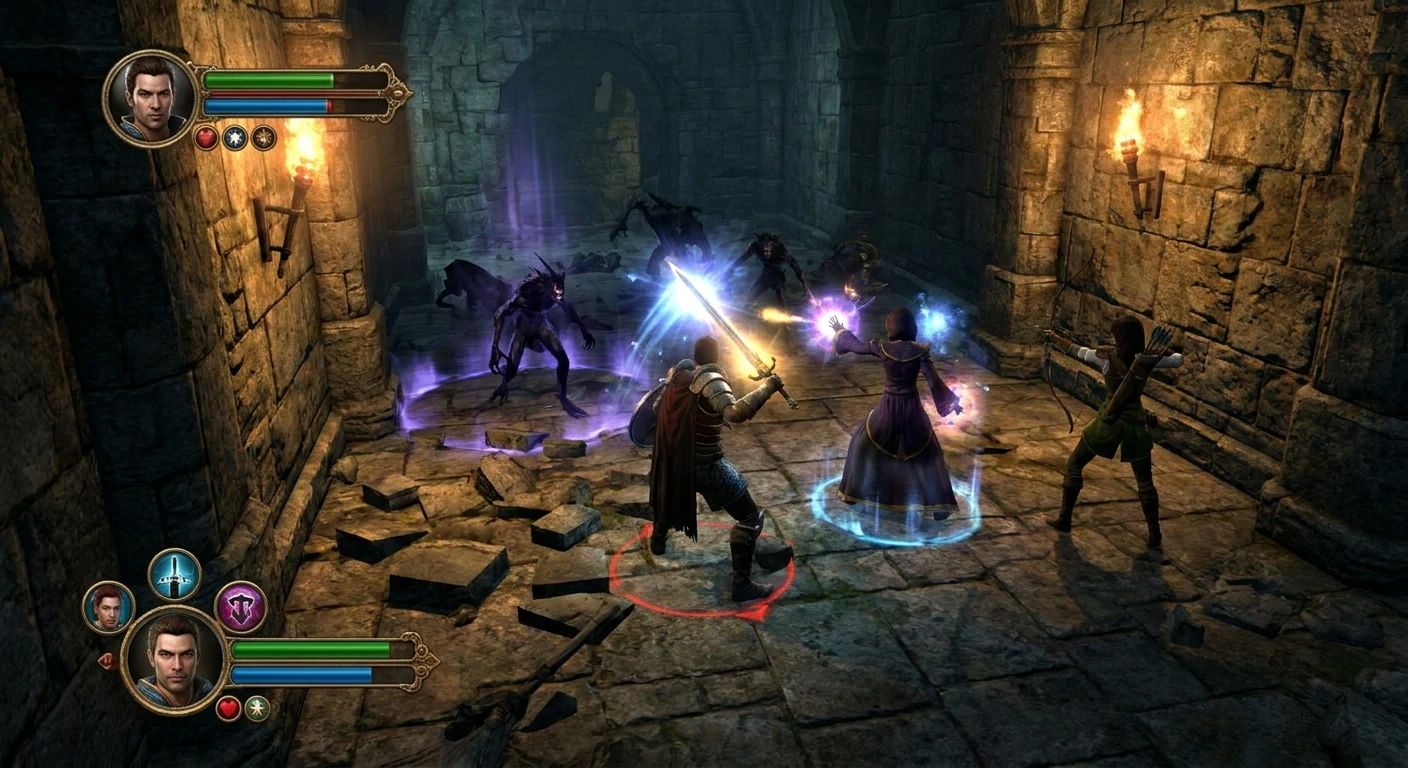
Why dungeon siege 3 Is My Ultimate Comfort Game
Hey everyone, let’s talk about dungeon siege 3 and why it completely consumed my entire weekend. Honestly, when I fired up this action RPG recently, I did not expect to lose track of time so completely. Living here in Kyiv, especially with the unpredictable rhythms of city life and the occasional grid hiccups we still navigate, having a perfectly optimized, story-rich game on my handheld console is an absolute lifesaver. I was just sitting in my favorite local coffee shop in Podil, sipping an espresso, when I realized this game is a masterful, underrated gem of the ARPG genre.
My main argument is simple: the gaming community gave this title a seriously unfair shake at launch, but looking back now, it did things with narrative and combat flow that modern titles still struggle to achieve. By seamlessly blending classic hack-and-slash mechanics with deep, choice-driven storytelling, it created a highly specific niche that remains unmatched. If you are exhausted by endless live-service grinds and just want a solid, complete, and engaging adventure that respects your time, you seriously need to give this one another look. The mechanics, the lore, and the pure joy of the co-op system make it an adventure worth taking, whether it is your first time or your fifth.
Read also: Ultimate Guide to the New soul frame Experience; Best multiplayer ps5 games to Play.
The Core Mechanics That Make It Shine
So, what actually makes this game so sticky and engaging? It comes down to a fundamental shift in how combat and character progression are handled. Most traditional action RPGs rely on spamming a single optimal skill while chugging health potions. Here, the developers implemented a stance-switching combat system that forces you to constantly adapt. You cannot just stand still and click; you have to actively manage your positioning, your current weapon stance, and your defensive maneuvers. It feels incredibly dynamic and responsive, almost like a brawler mixed with a traditional dungeon crawler.
Let’s look at a clear value proposition. The game offers four highly distinct characters, and playing each one feels like a completely different video game. For instance, playing as Katarina offers a ranged, highly mobile experience where you drop decoys and unleash rifle barrages. Conversely, picking Reinhart gives you a bizarre, highly tactical magic-user who manipulates space and time. You are not just picking a class; you are picking a fundamentally unique gameplay loop.
| Character Name | Combat Style | Primary Focus |
|---|---|---|
| Lucas Montbarron | Melee / Sword and Shield | Crowd Control and High Defense |
| Anjali | Spear / Fire Elemental | Stance Dancing and Area Damage |
| Katarina | Dual Pistols / Rifle | Mobility and Precision Ranged Strikes |
| Reinhart Manx | Entropic Magic | Trap Setting and Reality Alteration |
Here are the top three reasons the core loop remains incredibly addictive:
- Dynamic Stance Switching: Every character has two distinct stances. Switching between them mid-combat generates specific resources, forcing a beautiful, rhythmic flow to battles.
- Meaningful Loot Affixes: The gear system does not just boost raw numbers. It introduces bizarre modifiers like ‘Vampiric’ life-leech or ‘Doom’, which drastically alter how aggressive you can play.
- Consequential Narrative Choices: Unlike purely stat-driven games, the conversations you have with NPCs genuinely alter the political landscape of Ehb, changing boss encounters and the final ending.
Origins and Evolution of the Franchise
The Origins of the Ehb Universe
To truly appreciate what we have here, you have to look back at the roots of the franchise. The original games were massive, sprawling, almost automated party-management simulators created by Gas Powered Games. They defined a very specific era of early 2000s PC gaming. You would gather a massive train of pack mules and adventurers, marching across the Kingdom of Ehb in a seamless, loading-screen-free world. It was a technical marvel at the time, focusing heavily on continuous exploration and passive combat automation rather than twitch-action skills. The lore of the 10th Legion, the majestic settings, and the atmospheric music laid a massive foundation for the universe.
The Evolution Under Obsidian Entertainment
When the torch was passed to Obsidian Entertainment, the studio famous for their incredible writing and complex RPG systems, the formula saw a massive shift. They pivoted away from the passive, multi-character party management of the past and zoomed in closely on a tighter, more personal narrative. They introduced a fully voiced cast, intricate dialogue trees, and a lore-heavy political struggle involving the Jayne Kassynder rebellion. The combat became visceral and immediate. A lot of old-school fans resisted this change initially, missing their pack mules, but Obsidian injected a level of storytelling maturity and world-building that the franchise desperately needed. They made every single swing of the sword and every spoken word carry weight.
The Modern State in 2026
Now that we are deep into 2026, the perspective on this game has softened into genuine appreciation. The modern landscape is flooded with infinite-loot treadmills, making this curated, 15-hour narrative experience feel incredibly refreshing. It has found a massive second life on portable PC platforms and through backward compatibility. Modding communities have upscaled the textures, and players are finally recognizing that Obsidian actually crafted a phenomenally tight, well-written action RPG that simply carried a legacy title it had to fight against. It is no longer judged for what it wasn’t, but praised for what it actually is.
The Technical Engine Deep Dive
The Onyx Engine Architecture
Let’s get slightly nerdy and look closely at the technology powering this adventure. Obsidian built this game using their proprietary Onyx Engine. This was a monumental task because the engine had to handle drop-in/drop-out cooperative multiplayer seamlessly while maintaining a locked framerate during intense visual chaos. The Onyx Engine utilized an advanced deferred lighting pipeline, which allowed for dozens of dynamic light sources on screen simultaneously. When Anjali shifts into her fire form, the ambient glow interacts mathematically with the stone textures of the environment, casting real-time shadows from moving enemies. The collision detection was also remarkably tight for an ARPG, relying on capsule-based hitboxes rather than simple radius checks, meaning you can actually physically dodge arrows by a millimeter.
Mathematical Scaling in Loot Drops
The loot generation isn’t just random garbage; it follows a highly specific procedural scaling algorithm. The game checks your current level, the specific loot table of the enemy type, and your current story progress, generating items with heavily weighted affixes. It uses a dynamic RNG seed algorithm to ensure you aren’t getting completely useless stats for your chosen character.
- Dynamic Resolution Scaling: The engine actively monitors GPU load, subtly adjusting internal resolution to prevent frame drops during massive boss fights.
- Procedural Affix Weighting: If you play Lucas, the mathematical tables actively increase the drop rate of Block and Momentum stats by 15% behind the scenes.
- Asynchronous Network Prediction: In co-op, the netcode uses predictive character movement algorithms to hide latency, making hits feel immediate even on high-ping connections.
- Memory Garbage Collection: The engine streams level data aggressively in the background, keeping loading screens almost non-existent as you traverse different biomes.
Actionable 7-Day Playthrough Plan
Day 1: Picking Your Legionnaire
Your first day is all about commitment. Boot up the game and spend time reading the backstories of the four heroes. I highly recommend starting with Katarina if you love fast-paced kiting, or Lucas if you want a classic, chunky melee feel. Complete the prologue in the burning mansion, get a feel for the dodge mechanic, and secure your first companion.
Day 2: Mastering Dual Stances
On the second day, force yourself to stop button-mashing. Spend an hour in the Rukkenvahl forest actively switching between your primary and secondary stances. Learn how generating Focus in one stance allows you to unleash devastating magic in the other. If you master this rhythm now, the late-game bosses will be a breeze.
Day 3: Surviving the Rukkenvahl and Beyond
Day three is about pushing through the early political intrigue. You will face your first major boss encounters here. Start paying attention to dialogue options. Your choices with the townsfolk and political prisoners will dictate your reputation. Equip any gear that gives you ‘Vampiric’ stats to sustain your health through the longer dungeons.
Day 4: Deep Skill Customization
By day four, you will have leveled up enough to unlock weapon masteries. This is where you pause and read every tooltip. Do you want your shotgun blasts to pierce armor or light enemies on fire? Carefully allocate your proficiency points, as they drastically alter how your baseline attacks function. Specialize, do not generalize.
Day 5: Dominating Co-op Synergy
If you have a friend, day five is the time to invite them. The local or online co-op completely changes the dynamic. Practice layering your abilities. Have Lucas taunt the massive cyclops enemies while Katarina sets up a crossfire of traps. The synergy between characters was clearly the main focus of the development team.
Day 6: End-Game Gear Hunting
As you approach the Spire, the difficulty spikes. Day six is dedicated to gear optimization. Stop equipping items just because they have a higher armor rating. You need to look for specific synergies, like high ‘Doom’ percentages mixed with critical hit modifiers. Visit merchants, sell your junk, and buy specialized rings and amulets.
Day 7: Conquering the Treasures of the Sun
Your final day is for the DLC and the grand finale. The Treasures of the Sun expansion adds a fantastic desert hub, massive new boss fights, and an increased level cap. Take everything you have learned about stance dancing and gear synergy to defeat the final remnants of Kassynder’s forces. Enjoy the wildly different ending slides based on your specific dialogue choices.
Myths and Reality
Let’s clear up some massive misconceptions that still float around the internet about this game.
Myth: It is not a real entry in the franchise because it lacks party management.
Reality: While the mechanics changed, it massively expanded the lore, giving the 10th Legion an actual, emotionally resonant history rather than just being background text.
Myth: The co-op camera is completely broken and unplayable.
Reality: Local co-op restricts you to a shared screen, which requires you and your partner to stick together and communicate. It is a design choice meant to encourage tactical teamwork, not a glitch.
Myth: The loot system is boring compared to modern ARPGs.
Reality: The system is heavily streamlined, meaning every piece of gear you pick up has immediate, readable value without requiring a spreadsheet to understand.
Myth: The story is completely linear and choices don’t matter.
Reality: The ending features a massive Fallout-style slideshow that heavily details exactly how your specific dialogue choices shaped the future of multiple factions and cities.
Frequently Asked Questions
Can you play the entire game solo?
Absolutely. You are provided with AI-controlled companions that you can swap out. The AI is remarkably competent, handles its own healing, and actively draws aggro away from you during massive fights.
Does the game have full controller support?
Yes, and it is honestly the absolute best way to play. The twin-stick style movement and face-button stance switching feel incredibly natural on a gamepad.
Is Anjali overpowered for beginners?
Anjali is fantastic, but she requires high micromanagement. Her fire form deals massive area damage, but she is squishy. Lucas is actually the most forgiving character for absolute beginners.
What is the maximum level you can reach?
In the base game, the cap is 30. If you have the Treasures of the Sun expansion installed, the level cap increases to 35, giving you room to max out more proficiencies.
How long does it take to beat?
A standard playthrough, doing most of the side quests and listening to the dialogue, takes roughly 14 to 16 hours. It is the perfect length for a focused weekend gaming session.
Are the narrative choices actually impactful?
Yes. Deciding whether to execute or spare certain political figures will directly determine who controls massive regions of the kingdom in the epilogue.
Where can I buy it nowadays?
It is readily available on Steam, frequently goes on sale for a few dollars, and is fully backward compatible on modern Xbox consoles.
Final Thoughts
Listen, if you are craving a focused, beautifully atmospheric action RPG that skips the endless live-service grind and delivers pure, concentrated fun, you owe it to yourself to experience this. The intricate combat, the rich lore of Ehb, and the incredible replayability make it a standout title that has aged like fine wine. Dust off your controller, pick your Legionnaire, and start your adventure today. You won’t regret it!


Leave a Reply