Complete Guide: How to Get Maple Syrup Stardew Valley
Mastering how to get maple syrup Stardew Valley edition is a core part of your farming journey and a rite of passage for every new player moving into Pelican Town. When you first arrive on your overgrown plot of land, you are greeted by hundreds of wild trees, scattered debris, and endless possibilities. As you clear out space for your parsnips and potatoes, you might not immediately realize the immense value hidden within those basic wooden trunks. However, as you progress through your first spring, the game slowly introduces mechanics that require you to look beyond simple wood gathering. You will quickly find yourself needing sticky artisan goods for various town projects and crafting recipes. Generating this resource is not an instant process; it requires patience, strategic planning, and a basic understanding of the foraging skill tree. Your primary goal is to transition from simply chopping down everything in sight to managing a sustainable, passive resource farm. You need this golden liquid to finish the Chef’s Bundle on the Community Center bulletin board, and you definitely want it for crafting those highly lucrative Bee Houses. By establishing a proper tapping operation early in your playthrough, you set yourself up for massive financial success in the later seasons. Let us walk through the exact, step-by-step methodology required to secure a permanent supply of this valuable artisan good.
Extracting sap and resin from wild trees is deeply tied to your daily activities outside of standard crop farming. To successfully harvest this item, you need exactly two things: a Tapper and a mature Maple Tree. You cannot simply hit the tree with an axe or shake it to get the goods; you must craft specialized equipment. Why should you care so heavily about setting up this infrastructure? First, the value proposition is enormous when it comes to passive income. Example one: Crafting Bee Houses requires this specific sticky resource. A farm with fifty Bee Houses surrounding a single Fairy Rose flower can generate tens of thousands of gold pieces every few days without any daily watering or maintenance. Example two: The Chef’s Bundle in the Community Center absolutely requires it, which is a mandatory step toward repairing the town and unlocking the Greenhouse. Example three: You need it to cook the Maple Bar, an incredibly useful food item that grants massive buffs to your farming, fishing, and mining skills when consumed before a long day of labor. To fully understand the differences between the wild trees on your property, review the comparison table below.
Read also: Master the Iridium Sprinkler Range; The best summer crops stardew for gold.
| Resource Yield | Source Tree & Processing Time | Primary Game Uses |
|---|---|---|
| Maple Syrup | Maple Tree (9 In-Game Days) | Bee House Crafting, Chef’s Bundle, Maple Bar Cooking |
| Oak Resin | Oak Tree (7-8 In-Game Days) | Keg Crafting for Artisan Wine, Enchanter’s Bundle |
| Pine Tar | Pine Tree (5-6 In-Game Days) | Loom Crafting, Speed-Gro Fertilizer, Survival Burger |
Setting up your first extraction operation involves a specific sequence of gameplay milestones. You cannot build the necessary equipment on day one. You must follow these critical benchmarks:
- Reach Foraging Level 3 by chopping down trees and gathering wild forageables around the valley to unlock the crafting recipe.
- Gather 40 pieces of Wood and smelt 2 Copper Bars using a Furnace and Copper Ore from the upper levels of the Pelican Town mines.
- Identify a fully grown, mature tree of the correct species, place the crafted equipment on its trunk, and wait exactly nine in-game days for the harvest icon to appear.
Following these steps ensures a steady supply of artisan goods that will fund your farm’s expansion.
Origins of Tree Tapping in the Farming Genre
The concept of extracting resources from living trees has a rich history within farm simulation games. Early pioneers in the genre, like the classic Harvest Moon series, primarily treated trees as static obstacles or simple sources of lumber. You would upgrade your axe, chop the tree down, and wait for a new one to magically appear on your property. The introduction of sustainable forestry mechanics changed how players interacted with their virtual environments. When you look at how Stardew Valley implements this system, it clearly encourages long-term environmental management over short-term destruction. Players are rewarded for leaving mature trees standing and integrating them into their permanent farm layouts.
Evolution of Artisan Strategies
During the early days of the game’s release, many players simply sold their raw syrup for a quick 200 gold. It was a decent way to make pocket change during the slow winter months. However, as the community mapped out the most mathematically optimal ways to generate wealth, the meta shifted dramatically. Players realized that hoarding the resource to craft massive grids of Bee Houses yielded a significantly higher return on investment. The release of the massive 1.5 content update further evolved this strategy by introducing the Heavy Tapper. This late-game item, purchased from Qi’s Walnut Room on Ginger Island, revolutionized the artisan economy by cutting processing times completely in half, allowing for massive industrial-scale sap farming.
Modern State of Farm Layouts
Today, veteran players rarely keep their tree farms on their main property. Space on the standard farm map is highly valuable and better utilized for Ancient Fruit crops, giant Junimo Hut grids, or animal barns. The modern strategy involves planting dedicated tree farms in off-site locations. The Quarry, located in the mountains, is a massive, empty space perfectly suited for hundreds of trees. Similarly, the Train Railroad area and the sandy expanses of the Calico Desert are entirely plantable. Players tile these areas with pathways to prevent weeds from spawning and line up perfect grids of tapped trees, turning the entire valley into a massive, interconnected artisan factory.
Mechanics of Tree Growth and Tapper Yields
Understanding the underlying mathematics and RNG (Random Number Generation) of tree growth is vital for scaling your operation. Wild trees in Pelican Town progress through five distinct growth stages: seed, sprout, sapling, bush, and finally, adult tree. During the Spring, Summer, and Fall seasons, a planted seed has a flat twenty percent chance each night to progress to the next growth stage. This means a tree could theoretically grow to full size in just five days, or it could stubbornly take over a month if your luck is poor. Crucially, a tree will never progress from stage four to stage five if there is a fully grown tree occupying any of the eight tiles directly adjacent to it. You must space your seeds out properly, leaving at least one empty tile between every planted acorn, pine cone, or maple seed. Winter completely halts all wild tree growth unless you apply Tree Fertilizer, a craftable item made from fiber and stone that forces growth regardless of the freezing temperatures.
Optimizing the Nine-Day Production Cycle
Time management is the core gameplay loop of any farming simulator. Standard equipment requires exactly 13,000 in-game minutes to process sap into the final sweet product. Because you are awake for a limited time each day, this mathematically translates to exactly nine in-game days. Since a standard season is twenty-eight days long, you can expect just over three harvests per tree, per season. To maximize your time, you should plant your trees and place your equipment on the exact same day. This syncs up the production cycles, meaning you only need to run through your orchard once every nine days to collect everything simultaneously, rather than checking individual trunks every morning.
- Maple Trees have a distinct slightly curved, bare trunk and sparse, rounded yellow-green leaves compared to the bushy, dense foliage of oak trees.
- Standard extraction requires exactly 13,000 in-game minutes to produce the final product, which is the longest processing time of all three wild tree types.
- Heavy Tappers require Radioactive Bars to craft, but they drastically reduce the processing time to just four and a half days, doubling your annual yield.
- Trees do not need to be watered; they rely entirely on the daily twenty percent random growth chance built into the game’s code.
Step 1: Identify the Right Tree
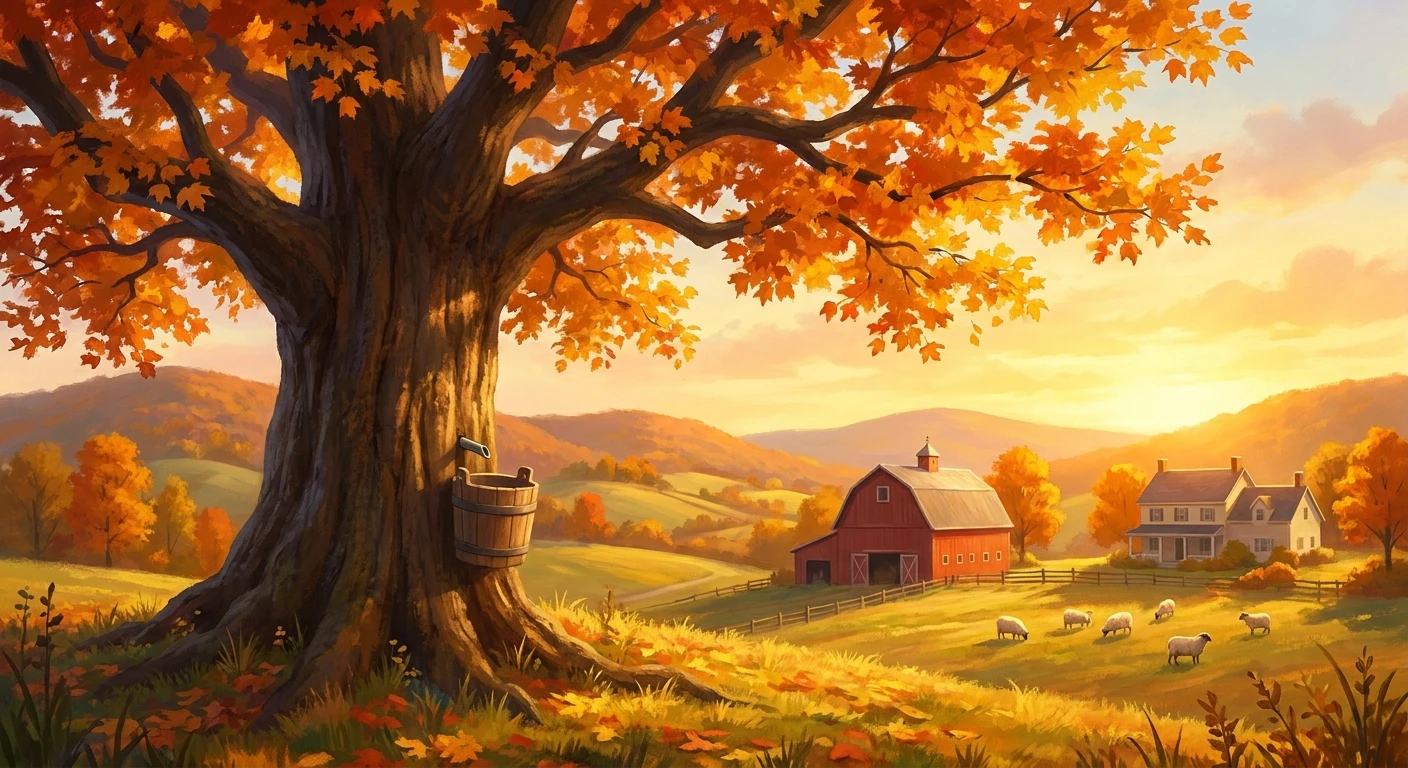
Before you invest resources, you must correctly identify the species you are looking for. Oak trees have bushy, rounded canopies that look like fluffy green clouds. Pine trees are tall, sharp, and triangular, like classic Christmas trees. You are looking for the third variant. These trees have a slightly thinner, more segmented canopy with a distinct yellow-green hue during the spring and summer. In the fall, they turn a vibrant, bright orange-red, making them incredibly easy to spot. If you are unsure, you can chop one down and look at the seeds that drop; you need to find the flat, winged seeds rather than acorns or pine cones.
Step 2: Level Up Your Foraging Skill
You cannot craft the required equipment until you reach Foraging Level 3. You earn foraging experience points by chopping down trees with your axe, removing large stumps, and picking up wild seasonal items off the ground like daffodils, leeks, and wild horseradish. Dedicate your first few days in spring to completely clearing a section of your farm. The wood you gather will be necessary for crafting chests and building repairs anyway, so the experience points are a natural byproduct of early-game progression.
Step 3: Mine Copper Ore
Once you have the recipe, you need raw materials. Head to the local mines situated in the mountains north of town. You will need to bring your pickaxe and traverse the upper levels, specifically floors two through thirty-nine. Look for the reddish-brown nodes scattered across the dirt and rock floors. Break these nodes to collect the raw ore. You need a total of ten pieces of raw ore to create the two bars required for a single piece of equipment.
Step 4: Smelt Copper Bars
Raw ore is useless on its own. You must build a Furnace using twenty pieces of ore and twenty-five stones. Place the Furnace on your farm. With ten pieces of ore and two pieces of coal in your inventory, interact with the Furnace. It takes thirty in-game minutes to process one bar. Wait patiently, collect your two shiny metal bars, and prepare for the final crafting phase.
Step 5: Craft and Place the Tapper
Open your main menu and navigate to the crafting tab. Locate the wooden barrel icon. Ensure you have the two metal bars and forty pieces of wood in your active inventory. Click the icon to craft the item. Walk up to a fully mature tree of the correct species. Select the item in your hotbar, and click directly on the tree trunk. You will hear a satisfying thud, and the wooden barrel will appear attached to the bark.
Step 6: Wait the Nine-Day Cycle
Now comes the hardest part: waiting. The production cycle takes exactly nine full days. You do not need to water the tree, check on it, or maintain the equipment. The process is entirely automated. Use this time to dive deeper into the mines, plant more parsnips, or build friendships with the local townsfolk. The cycle continues regardless of rain, sunshine, or seasonal changes.
Step 7: Harvest and Process
On the morning of the ninth day, you will walk past your tree and notice a large, floating icon of a glass bottle filled with amber liquid hovering over the barrel. Simply walk up and interact with the tree to pop the item into your inventory. The barrel remains on the tree and instantly begins the next nine-day cycle. You can now take your hard-earned harvest to the Community Center or save it in a chest to build your very first Bee House.
Myth: You Must Water Wild Trees
Myth: Many new players waste valuable time and energy carrying their watering can around the farm, sprinkling water on freshly planted acorns and winged seeds, believing it will speed up the growth process.
Reality: Wild tree species operate on an entirely different mechanical system than farm crops. They require absolutely zero water. Using your watering can on them does nothing but drain your daily stamina bar. Just plant the seed in a clear tile and let the daily twenty percent growth chance do the work automatically.
Myth: Tapping Harms or Kills the Tree
Myth: There is a common misconception that attaching industrial equipment to a living trunk will slowly drain its health, eventually causing the tree to wither, die, and disappear from the farm.
Reality: The game does not feature tree degradation. A tapped trunk is perfectly healthy and will continue to produce resources infinitely. Furthermore, it will continue to naturally drop seeds in the surrounding tiles, allowing you to passively grow a massive forest while simultaneously harvesting resources.
Myth: You Can Use Equipment on Fruit Trees
Myth: Players often buy expensive Apple, Cherry, or Pomegranate saplings from Pierre’s General Store, wait a full season for them to grow, and then try to attach sap-extracting equipment to them to get flavored artisan goods.
Reality: The equipment only functions on the standard wild species (along with Mahogany and giant Mushroom variants). Fruit trees strictly produce daily fruit during their designated season. Hitting a fruit tree with equipment will simply result in an error message.
Can you buy Maple Syrup in Stardew Valley?
Generally, no. Pierre and JojaMart do not sell this specific artisan good. You might get incredibly lucky and find it randomly stocked at the Traveling Cart in the Cindersap Forest on Fridays or Sundays, but relying on the cart’s randomized inventory is a terrible long-term strategy. You must produce it yourself.
How long does Maple Syrup take?
The standard equipment takes exactly nine in-game days, which calculates to 13,000 in-game minutes. If you manage to acquire the Heavy variant later in your playthrough, that time is drastically reduced to just four and a half days.
What does a Maple Tree look like?
They are distinct from the bushy oaks and triangular pines. They possess a slightly crooked, bare lower trunk with sparse, separated clusters of yellow-green leaves. In the fall season, they are instantly recognizable as they are the only wild trees that turn a brilliant, fiery orange.
Can I move a Tapper once placed?
Yes, the placement is not permanent. If you accidentally place it on the wrong trunk, or if you want to redesign your farm layout, simply hit the equipment once with your axe or pickaxe. It will pop off the trunk and return to your inventory intact.
Does winter stop syrup production?
No. While winter does completely stop wild trees from growing or spreading seeds naturally, it has zero effect on active extraction equipment. As long as the tree is fully mature and the barrel is attached, it will continue producing on its exact nine-day schedule throughout the freezing months.
What is Maple Syrup used for?
It is mandatory for completing the Chef’s Bundle. Beyond that, its primary use is crafting Bee Houses, which are massive money-makers. It is also a required ingredient for the Maple Bar cooking recipe, which provides excellent skill buffs for long mining runs.
Can you tap tree stumps?
No. If you chop a tree down and leave the bottom stump in the ground, you cannot attach any equipment to it. The tree must be fully mature, with a complete trunk and leafy canopy, to produce any artisan goods.
Conclusion: Mastering the Artisan Economy
Learning the ins and outs of tree tapping is a vital step in transforming your messy, overgrown starter farm into an optimized, highly profitable agricultural empire. By taking the time to gather copper, level up your foraging skills, and organize a dedicated grid of hardwood trunks, you guarantee a continuous, passive flow of valuable materials. Do not ignore your wild forests; they are just as important as your parsnips and pumpkins. Now go craft some furnaces, secure your sticky resources, and start building those lucrative Bee Houses today!




Leave a Reply