
The Truth About zariel bg3
Hey, let’s talk about the imposing figure of zariel bg3, the archdevil pulling the strings from Avernus. Honestly, understanding her backstory completely changes how you experience Karlach’s companion quest and the broader Baldur’s Gate 3 narrative. When I first booted up the game, I thought she was just another background villain, but her influence seeps into every single act of the story.
Back here in Kyiv, while sipping my morning coffee during a scheduled blackout, I spent hours analyzing her dialogue trees and lore books I hoarded in my camp chest. It hit me just how much her character mirrors the classic struggles with impossible choices. We often face situations where there are no perfect outcomes, and her tragic fall from grace perfectly embodies that feeling. Playing on my Steam Deck while wrapped in a blanket, I realized that Larian Studios didn’t just write a monster; they wrote a deeply complex fallen angel whose decisions ripple through the entire Sword Coast.
As we navigate through the massive RPG landscape, especially now that we are well into 2026, the community is still discovering subtle nods to her past. From hidden notes in the Lower City to ambient dialogue among tiefling refugees, the shadow of the Archduchess of Avernus is inescapable. If you want to truly grasp why Karlach is so desperate to stay in Faerûn, or why Wyll’s warlock pact is such a heavy burden, you absolutely need to comprehend who their tormentor really is. So grab a snack, get comfortable, and let me walk you through everything you need to know about the ruler of the first layer of the Nine Hells.
The Core of Her Influence
Why should you even care about her backstory? The value here is immense. Knowing her history gives you the context needed to make the best decisions for your party. For instance, when you finally meet Paladins of Tyr hunting Karlach, knowing they are actually cultists working for Avernus allows you to confidently side with the tiefling barbarian without second-guessing your moral compass. Similarly, understanding the strict, almost bureaucratic nature of hellish contracts gives you an edge when dealing with Mizora.
Her presence shapes the game in three primary ways that directly affect your gameplay experience. First, she provides the overarching antagonist force for two major origin characters. Second, she represents the lingering trauma of the Tiefling refugees you meet in the Emerald Grove, who were displaced because of her actions in the prequel tabletop adventure. Third, her mechanical obsession is the reason infernal iron exists as a crucial crafting material in the game.
| Lore Aspect | Impact on Game Narrative | Real Gameplay Consequence |
|---|---|---|
| Ruler of Avernus | Constant off-screen threat to the party | Agents and paladins will actively hunt your companions |
| Blood War General | Controls infinite military resources | Mizora holds massive leverage over Wyll’s spellcasting abilities |
| Former Solar Angel | Deep tragic undertones to her current cruelty | Specific dialogue options unlock if you know her holy origins |
If you skip reading the lore books, you miss out on massive context. Here are the main ways her legacy actively dictates your adventure:
- Karlach’s entire emotional core and mechanical engine are built around escaping the eternal servitude forced upon her by the Archdevil.
- Wyll’s warlock pact directly ties him to the infernal hierarchy, meaning every order he gets originates from the top brass of Avernus.
- The Tiefling refugees are completely displaced, facing racism and death on the roads, purely because their home city of Elturel was dragged into hell by her schemes.
The Origins of a Fallen Angel
Long before she grew horns and breathed hellfire, she was a Solar, a high-ranking angel from the heavenly plane of Mount Celestia. Her original mandate was to observe the Blood War, the eternal, bloody conflict between the chaotic demons of the Abyss and the lawful evil devils of the Nine Hells. She watched this endless slaughter for centuries, growing increasingly frustrated. She believed that the celestial host should intervene and wipe out both sides to protect the multiverse. Her passion was genuine, but it bordered on sheer fanaticism. She couldn’t understand why the other angels preferred to sit back and watch evil destroy evil.
This frustration slowly poisoned her mind. She gathered a massive army of mortal warriors from the city of Elturel, known as the Hellriders, and launched an unauthorized crusade directly into Avernus. She thought she could turn the tide with sheer righteous fury. However, the realities of hell are brutal. The demons and devils were too numerous, and her mortal army, terrified by the sheer scale of the horrors they faced, broke ranks and fled back through the portal, sealing it behind them and trapping their angelic leader in the hellscape.
Evolution into an Archdevil
Abandoned, defeated, and surrounded by the endless hordes of the Abyss and the Hells, she was eventually brought before Asmodeus, the Supreme Master of the Nine Hells. Asmodeus didn’t kill her. Instead, he did something far worse: he offered her a job. He pointed out that her celestial brethren abandoned her, while he recognized her tactical genius and her burning desire to destroy demons. He offered her the position of Archduchess of Avernus, putting her in charge of the very front lines of the Blood War she so desperately wanted to win.
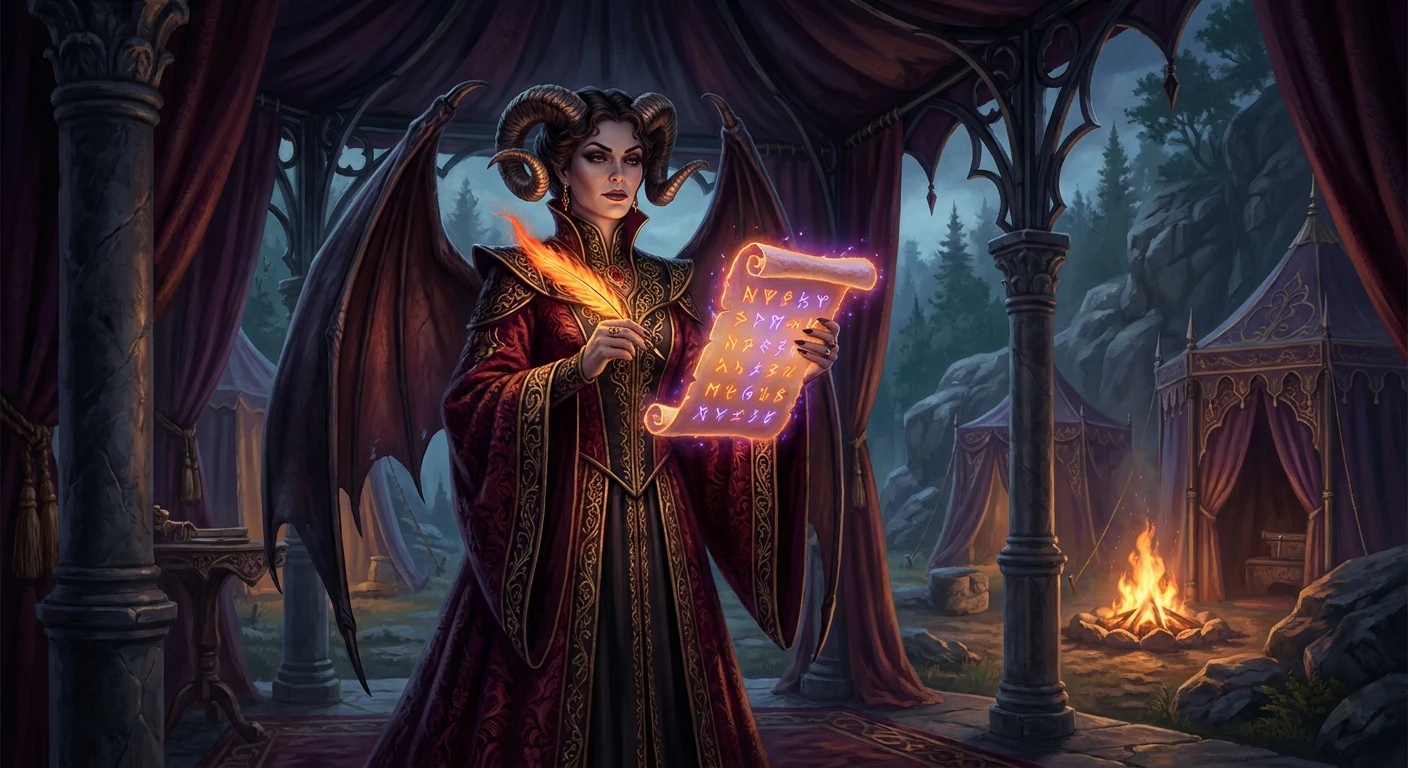
She accepted. The transformation from an angel of light to a fiend of fire was brutal and absolute. She lost her holy wings, replacing them with charred, bat-like appendages. Her angelic sword was corrupted by infernal magic. She became obsessed with military efficiency, completely abandoning her former compassion. To her, mortals were no longer souls to be saved; they were simply fuel for her war machines. This is where her obsession with infernal engineering began, setting the stage for everything that happens to our fiery companion, Karlach.
Her Modern State in Baldur’s Gate 3
By the time your party wakes up on the Nautiloid, her iron grip on Avernus is absolute. She doesn’t have time to chase a single escaped slave herself, which is why she delegates the task to agents like Mizora. She operates massive soul-forges, grinding up mortal essences to power her war machines. When you find pieces of infernal iron scattered across the Sword Coast, you are literally finding the scrap metal of her massive military industrial complex.
Her presence looms over the city of Baldur’s Gate as well. The refugees from Elturel are a direct result of her attempt to drag an entire mortal city into hell to use its citizens as fodder for the Blood War. Every time a tiefling is mistreated in the grove, or every time Karlach’s engine burns her from the inside out, you are feeling the direct impact of the Archduchess’s ruthless efficiency. She is the ultimate manager of misery, delegating pain while she focuses on fighting the demonic hordes.
Scientific and Technical Deep Dive
The Mechanics of Infernal Contracts
Let’s talk about the actual rules of how hell operates, because it’s fascinating. Infernal contracts aren’t just spooky magic; they are binding legal documents enforced by the metaphysical laws of the universe. When Wyll signed his pact, he didn’t just make a promise; his soul was literally tethered to the Nine Hells via a magical conduit. These contracts bypass normal magical resistances and cannot be broken by a simple Dispel Magic spell. They require loopholes, specific termination clauses, or the destruction of the contract holder.
The hierarchy of hell is extremely strict. Zariel, as an Archdevil, has the power to grant sub-pacts through her underlings. This means Mizora acts as a middle-manager. If you find a loophole in Mizora’s wording, the metaphysical law forces compliance. It’s essentially supernatural corporate law. We see this vividly when Wyll is punished and physically altered. The transformation isn’t a spell Mizora casts in the moment; it is a pre-programmed magical consequence written into the fine print of his original agreement.
Infernal Iron and Engineering
Then there is the physical science of Avernus. Hell isn’t just fire and brimstone; under her rule, it’s a heavily industrialized war zone. The infernal engine placed inside Karlach’s chest is a marvel of twisted engineering. It doesn’t run on blood or normal magic; it runs on extreme thermal energy generated by burning souls. The metal used, infernal iron, is anomalous. It absorbs ambient heat and radiates it inward, meaning it constantly requires cooling when outside of the hells.
- Infernal engines run on soul coins, which trap mortal essences to generate extreme thermal energy. The screaming faces on the coins are quite literal.
- The ambient temperature of Avernus physically alters beings not native to the plane over prolonged exposure, meaning prolonged stays require magical shielding.
- Infernal iron possesses anomalous properties that resist standard magical forging techniques, requiring a hell-touched smith like Dammon to mold it without it shattering.
- The thermodynamics of Karlach’s heart dictate that without a proper vent, the internal pressure will eventually cause a catastrophic somatic explosion.
Actionable Plan: Surviving the Archdevil’s Wrath
If you want to keep your party safe and help your companions overcome this massive threat, you need a solid plan. Here is my step-by-step strategy for handling her agents and fixing the mistakes of the past.
Step 1: Recruiting Karlach Early
Don’t wait around. Head to the Risen Road as soon as you hit level 3 or 4. You need to recruit Karlach before dealing with the Paladins of Tyr at the tollhouse. Having her in your party when you confront Anders gives you unique dialogue and ensures you don’t accidentally get tricked into killing one of the best companions in the game. Anders is a fallen paladin working directly for Avernus, so take him out quickly.
Step 2: Meeting Wyll and Mizora
Bring Wyll along when you recruit Karlach. The initial confrontation is tense, as Wyll’s contract forces him to hunt her. You need to persuade him that Karlach is not a devil, but a victim. Doing this triggers a visit from Mizora at your next long rest. This is your first real taste of hellish bureaucracy. Listen closely to Mizora’s wording, as understanding her rules is key to breaking Wyll’s pact later.
Step 3: Finding Infernal Iron
You need to scour Act 1 for infernal iron. There is a piece in the Blighted Village blacksmith’s basement, another in the Zhentarim hideout, and one in the Goblin Camp stash. Grab all of it. Do not sell it. This rare metal is the only thing that can cool down the engine in Karlach’s chest, and you will need multiple pieces as the game progresses.
Step 4: Upgrading the Engine in Act 1
Take the iron to Dammon, the tiefling smith in the Emerald Grove. He has experience with hellish machinery from his time in Elturel. He can perform the first upgrade on Karlach’s engine. This cools her down enough that she won’t burn everything she touches, though she still can’t be hugged just yet. Doing this cements her loyalty and stabilizes her condition for the journey to the Shadow-Cursed Lands.
Step 5: Navigating Act 2 Zariel Agents
When you reach the Last Light Inn in Act 2, find Dammon immediately. Give him the second piece of infernal iron. This second upgrade is crucial—it finally allows Karlach to touch people, opening up her romance path and deeply emotional dialogue. Meanwhile, keep an eye out for Mizora, who will pop up to demand Wyll rescue a high-ranking asset from Moonrise Towers. Spoiler alert: the asset is Mizora herself.
Step 6: The Final Upgrades
By Act 3, you’ve reached the city of Baldur’s Gate. Dammon has set up a new shop in the Lower City. If you bring him more infernal iron, he can craft unique armor sets for you. However, you will also learn the harsh truth: the engine cannot be permanently fixed on the material plane. The atmosphere of Faerûn is too cold, and the engine will eventually go critical. You have to start preparing for the ultimate choice regarding Karlach’s fate.
Step 7: Act 3 Confrontations
In the final act, you have to break Wyll’s pact. You will be given a choice: save Wyll’s father or break the contract. If you are clever, you can break the contract AND save his father by finding the Iron Throne prison independently. Defeating the hellish agents and securing your companions’ freedom is the ultimate middle finger to the Archduchess watching from below.
Myths & Reality
There is a lot of misinformation floating around forums regarding this specific storyline. Let’s clear up a few things.
Myth: You can fight the Archduchess directly as a secret boss in Act 3.
Reality: She never physically appears as a boss fight in the game. Her presence is strictly narrative and felt through her agents, paladins, and the emotional trauma of your companions.
Myth: You can easily cure Karlach’s engine with a high-level healing spell.
Reality: The infernal engine is a mechanical replacement for her biological heart. Magic cannot heal machinery. It requires specific infernal engineering and environmental conditions to remain stable.
Myth: Breaking Wyll’s pact immediately kills him or strips his warlock powers.
Reality: If you navigate the dialogue correctly in Act 3, Mizora is forced by the wording of the contract to release him while allowing him to keep his powers until the absolute threat is dealt with.
Myth: The ruler of Avernus is a one-dimensional evil monster.
Reality: Her backstory as a fallen celestial who sacrificed her morality in a desperate attempt to stop a greater evil makes her one of the most tragic and complex lore figures in the D&D universe.
FAQ & Final Thoughts
Can you romance her?
No, you absolutely cannot romance the ruler of Avernus. She is a background lore figure and antagonist, not a companion or interactive NPC in the camp.
Does she appear on screen in the game?
She does not have a physical character model that you can interact with in standard gameplay. She is seen only in brief stylized flashbacks and mentioned heavily in dialogue.
What level is she in traditional D&D?
In the tabletop 5e module, she is an incredibly powerful Challenge Rating 26 entity, meaning she could easily wipe the floor with a max-level Baldur’s Gate 3 party.
How does the Descent into Avernus module connect?
The tabletop module is a direct prequel. It details the fall of Elturel and the efforts to save it, which sets up the political climate and refugee crisis seen in Act 1.
Are there tieflings dedicated to her?
Yes, some tieflings have bloodlines tracing back to her, often exhibiting specific fiery smite abilities, though most tieflings in the game despise her for what she did to Elturel.
What is her signature weapon?
Before her fall, it was a holy longsword. Now, she wields a corrupted, massive flail or a hellfire-infused blade depending on the artistic depiction in the lore.
Can I save Karlach without crossing her agents?
No. Helping Karlach fundamentally requires you to kill the paladins hunting her and openly defy the orders coming out of Avernus.
Does Mizora answer directly to her?
Yes. Mizora is a cambion serving in her court. Every mandate Mizora enforces on Wyll ultimately comes from the top of the infernal chain of command.
In the end, even in 2026 with all the new updates and mods, the story of zariel bg3 remains one of the most compelling aspects of the game. Her unseen hand pushes the narrative forward, providing stakes, tragedy, and unforgettable companion arcs. I highly recommend taking the time to read the in-game books and exhaust every dialogue option to truly appreciate the depth of this world. Got your own strategies for dealing with hell’s agents? Share your thoughts below and let’s keep the discussion going!

Leave a Reply