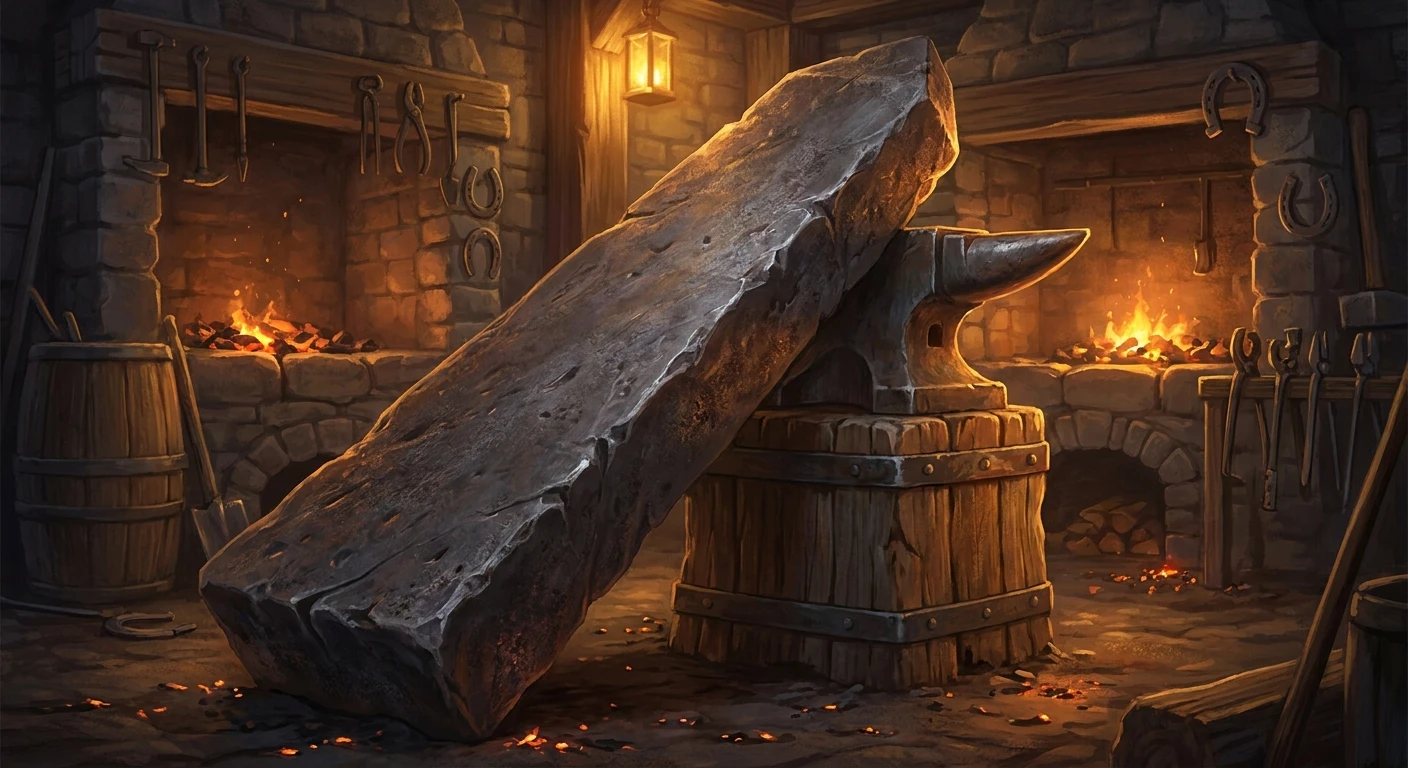
The Monumental Legacy of the Guts Sword
Have you ever looked at a totally unbelievable fantasy prop and thought, “Wow, I absolutely cannot look away from this masterpiece”? That is exactly the vibe you get when you first lay eyes on the guts sword. Let me tell you, it is an absolute unit of storytelling and character design that changed pop culture forever. Back in late 2025 and moving into the cold winter of 2026, I was wandering through a massive pop-culture and blacksmithing exhibition here in Kyiv. Local Ukrainian artisans were showing off gorgeous historical weapon recreations, and right in the middle of the crowded hall, someone had built a staggering life-sized replica of this dark fantasy icon. It was just a towering, terrifying slab of raw iron leaning against a heavy wooden post. Seeing it up close completely shifted my perspective on functional aesthetics. It is not just some ridiculous, exaggerated artistic choice; it represents a profound visual metaphor for carrying the unimaginable weight of trauma and surviving against absolutely impossible odds. Today, we are tearing down the rich lore, the completely broken real-world physics, and the enduring legacy of this monolithic weapon. You are going to understand exactly why this oversized piece of metal dominates the minds of fans and creators alike, completely reshaping the landscape of dark fantasy media from the ground up.
When you look at the fundamental design of this monstrosity, usually referred to by fans and lore enthusiasts as the Dragon Slayer, you quickly realize it defies every single convention of traditional weapon craft. Historically, a blade needs perfect balance. It requires a weighted pommel that counteracts the heavy mass of the steel, allowing the user to pivot the point with agility and precision. This specific fictional weapon completely abandons agility in favor of raw, catastrophic kinetic energy. The creator designed it specifically as an over-the-top joke taken to its absolute extreme—a master blacksmith tasked with making something that could slay a mythical beast created something so unbelievably heavy no normal person could even budge it off the floor.
Let us map out a quick comparison to see just how absurd the proportions actually are when placed next to real-world historical weapons of war.
| Weapon Designation | Average Real-World Weight | Primary Combat Purpose |
|---|---|---|
| The Dragon Slayer | Approx. 400 lbs (Fictional) | Obliterating massive demonic entities and armored monsters |
| German Zweihänder | 4.5 to 7 lbs | Breaking rigid pike formations on the Renaissance battlefield |
| Scottish Claymore | 5 to 6 lbs | Highland infantry skirmishes and localized clan warfare |
Why do millions of fans obsess over this seemingly impractical design? You get two distinct artistic benefits that elevate the entire narrative. First, the unparalleled visual impact. Every single time the weapon hits the ground, the artwork shows it shattering the cobblestone. It tells you immediately that the wielder possesses superhuman resilience without needing a narrator to explain it. Second, the tactile feedback of the story itself. When the character swings it, the framing conveys the inertia, the brutal strain on human muscles, and the sheer unstoppable momentum.
Here are three fundamental reasons this monolithic weapon altered pop culture permanently:
- Unprecedented Scale: Before this creation debuted, fantasy heroes mostly used sleek, magical, glowing blades. This raw chunk of iron completely normalized the “oversized heavy weapon” trope in media.
- Conceptual Evolution: The weapon actually grows with the character’s suffering. It starts as a mundane chunk of steel and slowly absorbs the astral properties of the supernatural beings it crushes over years of combat.
- Visual Storytelling Mastery: The blade is perpetually nicked, violently scratched, and deeply stained, reflecting the brutal, endless journey of its master perfectly. It speaks volumes of backstory without a single line of spoken dialogue.
The Forging Origins
The origin story begins with a humble but brilliantly stubborn blacksmith named Godot, living far away from the politics of the royal court. Long ago, he was commissioned by a wealthy, arrogant king who demanded an extravagant weapon capable of bringing down a mythical dragon. While the other royal smiths crafted elegant, highly decorative pieces that looked incredibly pretty but lacked any real function, Godot took the ridiculous request completely literally. He decided that to kill a monster, you needed a monster of a weapon. He forged a slab of iron so thick and ridiculously heavy that it was practically a joke. The king, deeply insulted by this crude slab that his strongest knights could not even lift, banished the honest blacksmith. The blade sat collecting thick layers of dust in a remote wooden shed for years, just waiting for a master crazy enough to pick it up.
Evolution Through the Golden Age
It is crucial to remember that the protagonist did not start his brutal journey with this specific, legendary weapon. In his younger mercenary days during the fabled Golden Age, he wielded massive, oversized greatswords, but they were still somewhat grounded in reality—at least compared to the monstrosity that came later. Those earlier blades often chipped, bent, or completely shattered during intense, prolonged skirmishes involving dozens of armored knights. They were merely stepping stones in his combat evolution. The constant breaking of conventional steel forced the narrative to eventually provide something entirely unbreakable, something that perfectly matched his evolving physical strength and his growing, unstoppable rage.
Modern Cultural State
Fast forward to the current year of 2026. Look around at the massively successful video game industry. You see towering slabs of iron dominating the gameplay in massive franchises like Dark Souls, Monster Hunter, and Final Fantasy. Every single one of those comically large greatswords owes its very existence to the foundational blueprint laid out by the legendary manga artist Kentaro Miura. It established an entire subgenre of aggressive weapon design. Instead of graceful, dancing fencing routines, combat aesthetics shifted heavily toward brutal, weighty strikes where the character’s recovery time is just as dangerous as the swing itself. The legacy of this slab of iron is permanently etched into our modern pop culture vocabulary.
Metallurgy and Raw Mass
Let me stop you right there before you try to apply real-world physics to this beautiful nightmare. If we accurately calculate the visual dimensions—roughly 6.5 to 7 feet long, well over a foot wide, and a couple of thick inches deep—and assume it is forged entirely from standard high-carbon steel or cast iron, the resulting weight is utterly catastrophic. You are looking at roughly 400 to 450 pounds of dead, unyielding weight. Normal human muscle fibers simply cannot generate the necessary torque to swing 400 pounds attached to a relatively short lever (the handle). Your spine would snap under the compression, and your shoulders would immediately dislocate from the sockets. The center of gravity is positioned far too far up the blade, meaning the user is essentially trying to swing a small motorcycle horizontally by holding onto the handlebars.
The Biomechanics of Swinging It
But that absolute defiance of physics is exactly what makes the dark fantasy so compelling. The protagonist relies heavily on a specialized mechanical prosthetic arm equipped with a hidden magnetic grip or locking mechanism to help brace against the sheer recoil of his swings. He uses his entire body weight dynamically, planting his feet firmly into the dirt and violently rotating his hips, essentially acting as a human counterbalance to a falling building.
Let us look at some strictly hypothetical scientific facts if this thing actually existed in our physical universe:
- Dimensions and Volume: Approximating the visual measurements at 72 x 12 x 2 inches yields about 1,728 cubic inches of solid iron.
- Weight Profile: Based on the known density of iron (roughly 0.284 pounds per cubic inch), the raw metal alone easily tips the scales at nearly 490 pounds before adding the hilt hardware.
- Kinetic Energy Transfer: If swung at a conservative speed of 30 miles per hour, the impact force would shatter medieval plate armor instantly, acting vastly more like a demolition wrecking ball than a traditional edged weapon.
- Structural Integrity: The sheer thickness completely prevents it from warping. A normal sword flexes upon impact; this monolithic pillar absorbs the massive shock, transferring violent vibrations directly into the hands of whoever is foolish enough to hold it tight.
Day 1: Blueprinting the Behemoth
Building your own cosplay replica is the absolute best route to experience the imposing presence of the guts sword without destroying your skeletal system. Start by scaling the weapon to your own personal height. It should ideally sit just a few inches above the top of your head. Roll out large sheets of kraft paper on the floor and sketch out the exact dimensions. This paper template will serve as your guiding map for the entire build process.
Day 2: Selecting Lightweight Materials
Listen closely: do not use actual wood for the main blade. Wood gets shockingly heavy at that extreme size, and you will hate carrying it around a convention floor. Instead, go grab several thick mats of high-density EVA foam and a sturdy, thick-walled PVC pipe to serve as the unbreakable internal skeleton of the prop.
Day 3: Structuring the Core
Run the PVC pipe straight down the middle of the blade area. This acts as both the handle at the bottom and the supportive spine throughout the weapon. Generously apply strong contact cement and glue your thick layers of EVA foam directly onto either side of the pipe, sandwiching it in the middle. Press firmly and make sure the adhesive cures completely in a well-ventilated area.
Day 4: Shaping the Beveled Edges
Grab a high-speed rotary tool or a sharp utility knife with a box of fresh, snap-off blades. Carefully carve down the long edges to create that signature, harsh diamond cross-section. Always wear a protective dust mask during this step, because fine foam dust will get absolutely everywhere in your workspace.
Day 5: Priming and Sealing
Raw foam acts exactly like a dry sponge, so you need to seal it before painting. Apply several thick, even coats of Plasti Dip or a specialized flexible cosplay primer. This crucial step gives the porous surface a remarkably smooth, paint-ready finish that will not crack when the prop inevitably bends slightly.
Day 6: Metallic Painting Techniques
Spray the entire massive prop with a flat, matte black base coat. Once that dries completely, take a wide, dry brush, dip it very slightly in bright silver acrylic paint, and aggressively drag the bristles across all the raised edges and flat panels. This dry-brushing technique perfectly simulates heavy, worn steel catching the light.
Day 7: Adding Battle Damage and Weathering
The blade should look like it has been dragged through literal hell. Use a hot soldering iron to carefully melt deep scratches, monster claw gouges, and heavy dents into the foam surface. Finally, wash the entire surface with heavily diluted brown, black, and dark orange acrylic paints, wiping the excess away with a rag. This leaves grime in the recesses, creating hyper-realistic dirt and dried rust effects.
People have formed some incredibly wild misconceptions about this iconic blade over the decades. Let us clear up the widespread confusion right now.
Myth: A strongly built human could eventually train at the gym to lift and swing it realistically.
Reality: Human physics strictly forbids it. The extreme leverage required to horizontally swing 400 pounds attached to a short stick would instantly rip human tendons apart and hopelessly crush the spinal column.
Myth: It is exceptionally sharp and gracefully slices through thick armor like hot butter.
Reality: The original manga explicitly states it is essentially a blunt, unrefined slab of iron. It does not slice cleanly; it viciously crushes, bludgeons, and violently rips through targets entirely via unstoppable kinetic momentum.
Myth: The weapon was forged long ago with powerful magical enchantments.
Reality: The master smith Godot forged it strictly as mundane, non-magical iron. It only gained its supernatural, astral-cutting properties after years of continuously bathing in the blood and ethereal energy of monstrous, otherworldly entities.
Myth: The design was lazily copied from massive video game swords.
Reality: It is exactly the opposite scenario. This specific manga design pioneered the oversized weapon trope in the late 1980s, serving as the direct inspiration for virtually every giant sword seen in gaming history since.
FAQ 1: How heavy is the blade theoretically?
Most dedicated fans and enthusiastic engineers calculate the raw weight to be somewhere between 400 and 500 pounds based on its visual dimensions and the density of solid iron.
FAQ 2: Who actually forged the weapon in the lore?
It was painstakingly crafted by the master blacksmith Godot, an incredibly talented artisan who lived in deep isolation away from the kingdom.
FAQ 3: How long is the entire weapon from pommel to tip?
It is generally depicted as being noticeably taller than its already tall wielder, putting it right around a staggering 6.5 to 7 feet in total length.
FAQ 4: Is it actually sharp on the edges?
No, not in the traditional sense. It is repeatedly described as a massive, unrefined heap of raw iron that brutally bludgeons its targets rather than slicing them cleanly.
FAQ 5: What specific material is it made of?
It is forged from entirely ordinary, mundane iron and steel, utterly lacking any mythical fantasy metals like mithril or adamantium in its original construction.
FAQ 6: Does it possess inherent magical powers?
Not initially. However, it slowly absorbed residual spiritual energy from brutally defeating countless demonic, supernatural beings over an extended period of time.
FAQ 7: Why does the metal never shatter in combat?
Its sheer, ridiculous thickness and immense physical density make it structurally invincible against standard medieval weapons and monstrous impacts.
FAQ 8: Can any other character in the story lift it?
Very few. While some incredibly powerful supernatural entities can physically move it, no normal human besides the protagonist possesses the strength to swing it effectively.
FAQ 9: How does he comfortably carry it around?
He utilizes an intricate set of heavy leather harnesses and custom metal chains strapped tightly across his broad back to securely anchor the massive weight when traveling.
FAQ 10: What does the massive sword truly symbolize?
Ultimately, it acts as a striking physical manifestation of the protagonist’s immense trauma, his unwavering sheer willpower, and his endless burden of fighting against a cruel destiny.
In conclusion, the legendary guts sword is way more than just a really cool anime drawing. It is a legendary piece of storytelling hardware that completely defined an entire generation of dark fantasy aesthetics. It teaches us about the sheer visual power of exaggeration and the weight of narrative symbolism. Want to master even more knowledge about epic fantasy weapons? Go check out our other deep dives into pop culture blacksmithing and tell us what massive weapon you would build in the comments below!


Leave a Reply