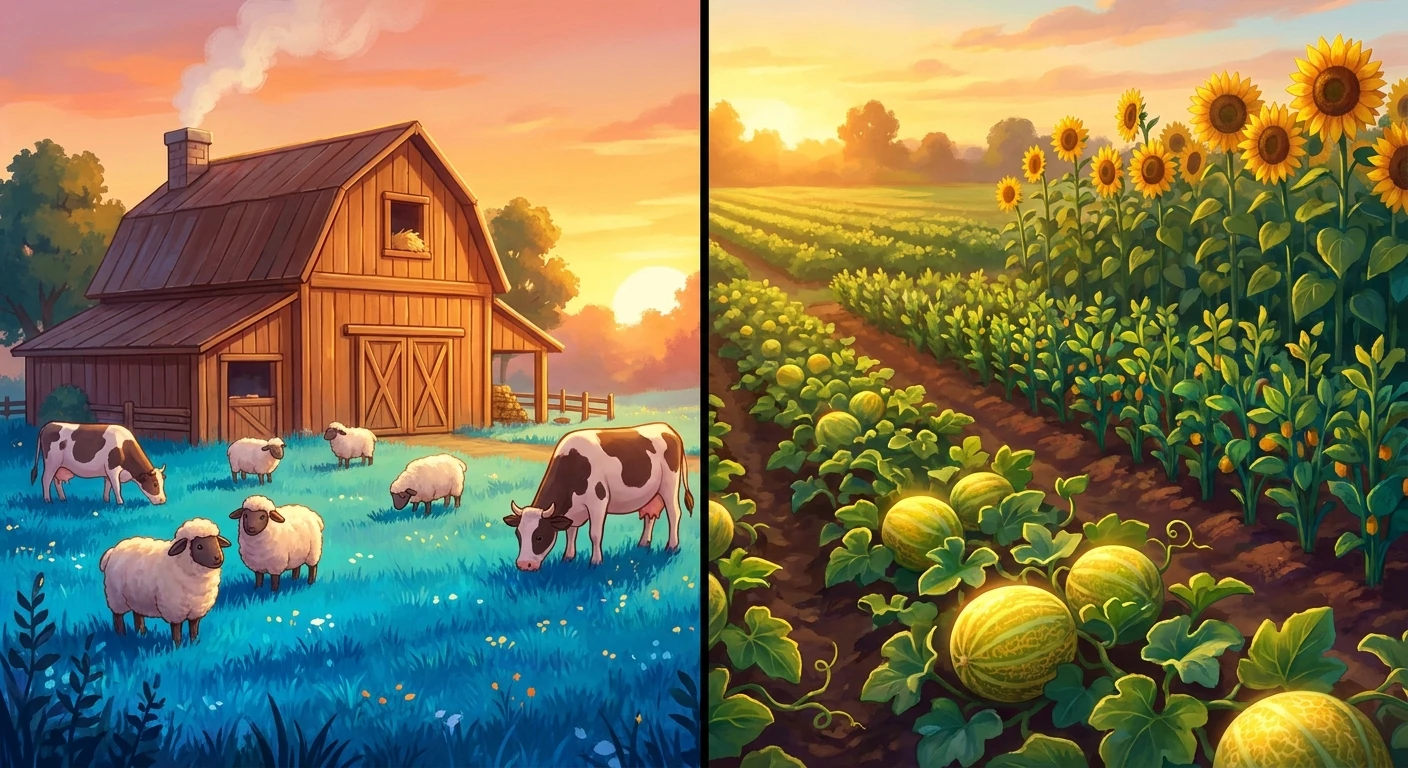
Stardew Valley Rancher or Tiller: Making the Big Choice
Hey friends! So, you have finally been grinding enough parsnips and petting enough chickens to hit Farming Level 5, and suddenly the screen goes dark. A menu pops up, forcing you to make the ultimate decision: stardew valley rancher or tiller. If you are staring at your monitor right now agonizing over which button to click, trust me, you are not alone. Almost every player hits this exact roadblock and panics, thinking they might ruin their entire farm’s economy with a single misclick.
Just the other week, I was hanging out in a cozy underground cafe here in Kyiv, sipping a latte while the power grid held strong, starting up my tenth farm save. Even now, deep into 2026, with all the countless hours I have logged, hitting that Level 5 milestone still gives me a tiny pause. Choosing between animal products and crops totally dictates the rhythm of your daily routine. Will you be spending your mornings gently petting cows and gathering eggs, or will you be managing vast grids of sprinklers and optimizing your harvest cycles?
This is not just a minor buff. Your choice right now dictates the massive Level 10 profession you get later, which literally defines your endgame wealth. So grab a snack, sit back, and let me break down exactly how you should handle this choice without stressing out.
Read also:
- Miner or Geologist Stardew Guide: The Best Choice
- Best Skate 3 Cheat Codes to Unlock Everything
- Stardew Valley Rancher or tiller: Best Choice Guide
The Core Mechanics: Breaking Down the Professions
To really get a grip on this choice, we need to look at the exact numbers and what these paths open up for you down the road. The game gives you a flat immediate bonus, but the real secret lies in what happens when you finally reach Level 10.
| Profession Name | Immediate Bonus (Level 5) | Level 10 Unlock Options |
|---|---|---|
| Tiller | Crops sell for 10% more | Artisan (Goods worth 40% more) OR Agriculturist (Crops grow 10% faster) |
| Rancher | Animal products sell for 20% more | Coopmaster (Incubate faster, befriend coop animals) OR Shepherd (Befriend barn animals, faster wool) |
| Verdict | Tiller starts slow | Tiller scales infinitely better due to Artisan |
The value proposition here is pretty stark once you map it out. Tiller gives you a very modest 10% boost to raw crops. Early on, when you are selling raw blueberries or melons, that extra 10% feels okay, but nothing crazy. However, the true value of Tiller is the gateway it provides to the Artisan profession at Level 10. Artisan makes all your wine, cheese, mayonnaise, and truffle oil sell for 40% more. That is astronomical. On the flip side, Rancher gives you a juicy 20% boost to raw animal products like milk and eggs immediately. If you love a farm full of animals, this feels great early on. But its Level 10 options focus heavily on animal friendship and specific product speeds, which frankly, do not scale as hard economically.
Before you click that button, you need to weigh three massive factors:
- Your Tolerance for Daily Chores: Let’s be real. Animals require daily love. You have to walk in, pet them, gather their stuff, and make sure they have hay. Crops, once you get quality sprinklers, are entirely passive until harvest day. If you hate daily chores, leaning towards crops is the play.
- Your Endgame Money Goals: If you want to buy the Gold Clock or the Return Scepter as fast as humanly possible, you need millions of gold. Ancient Fruit wine aged in casks with the Artisan buff is the mathematically proven fastest way to get there. Tiller is a mandatory stepping stone for that.
- Your Farm Layout: If you picked the Meadowlands farm layout, you start with a coop and lovely blue grass. The game actively encourages you to lean heavily into animals early. In that specific scenario, Rancher can give you a massive early-game cash injection to snowball your farm faster than raw crops would.
Origins of Farming Professions
To really appreciate the design, we have to look back at the roots of the game. When Eric Barone built these systems over a decade ago, he wanted to heavily emulate classic farming RPGs while giving players distinct, branching paths. The idea was to make you feel like a specialist. You were not just a generic farmer; you were the town’s premier wine-maker or the region’s top shepherd. Back in the early days, the balance was a bit wonky, and almost everyone defaulted to one path because the alternative just didn’t pay the bills.
Evolution Through Game Updates
Over the years, massive patches totally shook up how we value these choices. The introduction of auto-petters and auto-grabbers changed the animal game forever. Suddenly, having a massive barn of pigs wasn’t a tedious nightmare of clicking every morning; it was an automated money-printing factory. Ostrich incubators and golden chickens added entirely new late-game tiers to animal farming, making the Rancher path vastly more appealing to players who felt left behind by the massive crop empires.
The Modern State of the Meta
Fast forward to the current landscape. Here in 2026, the community meta is highly refined. Most hardcore min-maxers still preach the gospel of the Tiller-to-Artisan pipeline because the raw math on aged Starfruit wine is completely unbeatable. However, cozy gamers have largely embraced the flexibility. Because we now have so many quality-of-life tools, choosing Rancher doesn’t mean you are severely punished. It just means your farm has a different flavor and a slightly different income curve.
The Mathematical Breakdown of Crop vs Animal Profits
Let’s talk pure, unfiltered numbers. When you are standing in front of your shipping bin, the game runs a very specific set of algorithms to determine your payout. If you choose Tiller, every raw crop you toss in the bin gets its base value multiplied by 1.1. So, a standard Melon base price is 250g. With Tiller, it becomes 275g. It seems small, but when you harvest 300 melons at once, that is an extra 7,500g generated from absolutely nowhere. That buys you a lot of seeds for the next season.
Processing Algorithms and Base Value Multipliers
Things get wild when you start processing. Let me explain simply how the engine calculates artisan goods. When you turn a fruit into wine, the game takes the base raw price of the fruit, multiplies it by 3, and adds nothing else. If you are a Tiller, your 10% buff to raw crops completely vanishes the second that crop goes into a keg. The keg does not care about your Tiller buff. However, if you chose Tiller and then pick Artisan at Level 10, the finished wine gets a 40% multiplier applied to its final value.
- Raw Starfruit: Base price 750g. With Tiller, sells for 825g.
- Starfruit Wine (No Artisan): Base price 2,250g.
- Starfruit Wine (With Artisan): Sells for a staggering 3,150g per bottle.
- Raw Cow Milk: Base price 125g. With Rancher, sells for 150g.
- Gold Star Cheese: Base price 345g. If you have Artisan, it sells for 483g. (Notice how Artisan buffs animal products too!)
This is the ultimate secret: the Artisan profession (which requires Tiller) actually boosts processed animal products like cheese, mayo, and cloth. Rancher boosts the raw animal products, but prevents you from getting the 40% boost on the processed versions later. This mathematical quirk heavily skews the late-game economy.
Actionable Plan: Navigating the Level 5 Transition
If you are frozen on the level-up screen right now, do not panic. I have put together a step-by-step mental checklist you can follow to ensure you make the best choice for your current save file.
Step 1: Assess Your Current Farm Layout
Take a hard look at your actual farm space. Do you have massive, wide-open fields perfect for hundreds of crops, or are you playing on the Riverland or Hill-top maps where tillable soil is heavily restricted? If you lack farming space, animals might be your primary income source by default.
Step 2: Audit Your Daily Energy Consumption
Think about your stamina bar. Are you exhausted by 10 AM from watering? If you do not have the resources to build dozens of quality sprinklers right now, heavily expanding your crop fields to utilize Tiller might just lead to total burnout. Animals require zero energy to pet.
Step 3: Count Your Active Silos and Barns
Before committing to Rancher, look at your infrastructure. Do you have a silo? Do you have enough hay to survive the upcoming winter? Rancher is only good if your animals are actually producing. Unfed animals produce nothing, making the profession entirely useless during a hay shortage.
Step 4: Make the Level 5 Selection
Once you weigh the above, click the button confidently. My general advice? Click Tiller 90% of the time purely to secure Artisan later. If you are doing a challenge run, an animal-only farm, or playing the Meadowlands map, click Rancher for the fun of it.
Step 5: Transition Your Processing Gear
Immediately start crafting the machines that fit your choice. If you went Tiller, start tapping oak trees and building kegs and preserves jars. If you went Rancher, start building cheese presses and mayonnaise machines to process your goods, though ironically, raw iridium quality products might sometimes out-price standard processed goods with Rancher.
Step 6: Plan Your Next Five Levels
Getting from Level 5 to Level 10 takes significantly longer than getting from 1 to 5. You need to aggressively plant high-yield crops or buy lots of animals to grind that XP. Pumpkins in Fall and Melons in Summer yield massive farming XP upon harvest.
Step 7: The Statue of Uncertainty
Breathe easy knowing that your choice is not permanent. Later in the game, once you unlock the Sewers, you will find the Statue of Uncertainty. For a mere 10,000 gold, you can offer a tribute to the statue, go to sleep, and completely respec your farming professions. You are never permanently locked in.
Myths vs. Reality
There is a ton of misinformation floating around Reddit and Discord about this specific choice. Let me clear up a few glaring misconceptions right now.
Myth: Rancher is completely useless and a total trap.
Reality: Not entirely true. While it loses to Artisan mathematically late-game, Rancher provides a massive and highly reliable cash flow in your first year when you desperately need funds for bag upgrades and tool upgrades.
Myth: Tiller boosts the price of foraged berries and truffles.
Reality: Absolutely not. Truffles are classified as forage, not crops. Tiller does nothing for them. You need the Foraging skill tree (Gatherer/Botanist) to boost raw truffle quality and double harvest rates.
Myth: You must choose Tiller to make any real money in the game.
Reality: A massive barn filled with pigs finding Iridium-quality truffles (using the Botanist foraging profession) is one of the highest-grossing strategies in the game, completely bypassing the Farming profession tree entirely.
Frequently Asked Questions & Conclusion
Can I change my profession later?
Yes! As soon as you unlock the Sewers, you can pay the Statue of Uncertainty 10,000g to change your mind.
Does Tiller affect fruit trees?
Yes, raw fruits from your apples, pomegranates, and cherry trees will get the 10% price bump when tossed directly into the shipping bin.
Do truffles get the Rancher buff?
No. Truffles are strictly considered a forage item, even though pigs dig them up. They rely on your foraging skill level.
Is mayonnaise buffed by Rancher?
No. Mayonnaise is an Artisan Good. Rancher buffs the raw egg, but to buff the mayonnaise, you specifically need the Artisan profession (which comes from the Tiller path).
Does Tiller affect greenhouse crops?
Absolutely. Any crop grown anywhere—your farm, the greenhouse, or Ginger Island—benefits from the Tiller price increase.
What happens in multiplayer co-op?
Professions apply to the person who places the item in the shipping bin. If you have Tiller and your friend has Rancher, you should be the one putting crops in the bin, and they should ship the raw milk.
How do I level up farming super fast?
Planting massive grids of cheap, fast-growing crops. Harvesting gives XP, not watering. Crops that regrow (like blueberries and cranberries) give XP every single time you harvest them.
So there you have it, the ultimate breakdown. Whether you decide to build a sprawling crop empire as a Tiller or manage a cozy, chaotic barn of animals as a Rancher, just remember that the game is meant to be fun. Do what fits your personal vibe, because you can always visit the sewers later if you change your mind. Drop a comment below and tell me: are you Team Crops or Team Animals on your current playthrough? Happy farming!
Read also:


Leave a Reply